 TopWeb3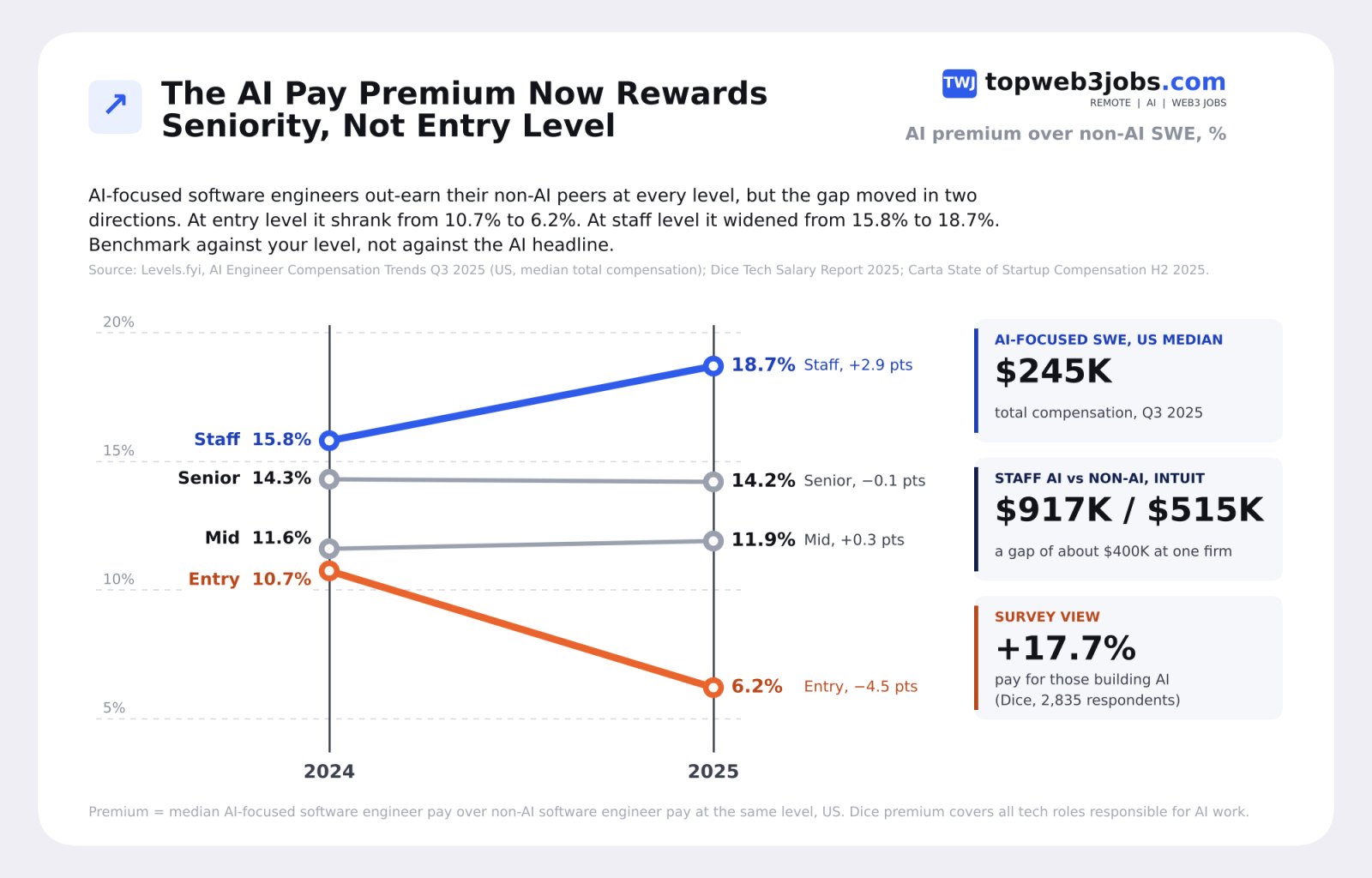
Key Data
- AI-focused software engineers in the US earned a median $245,000 in total compensation in Q3 2025, according to Levels.fyi
- The AI premium depends on level. It fell from 10.7% to 6.2% at entry level and rose from 15.8% to 18.7% at staff level between 2024 and 2025
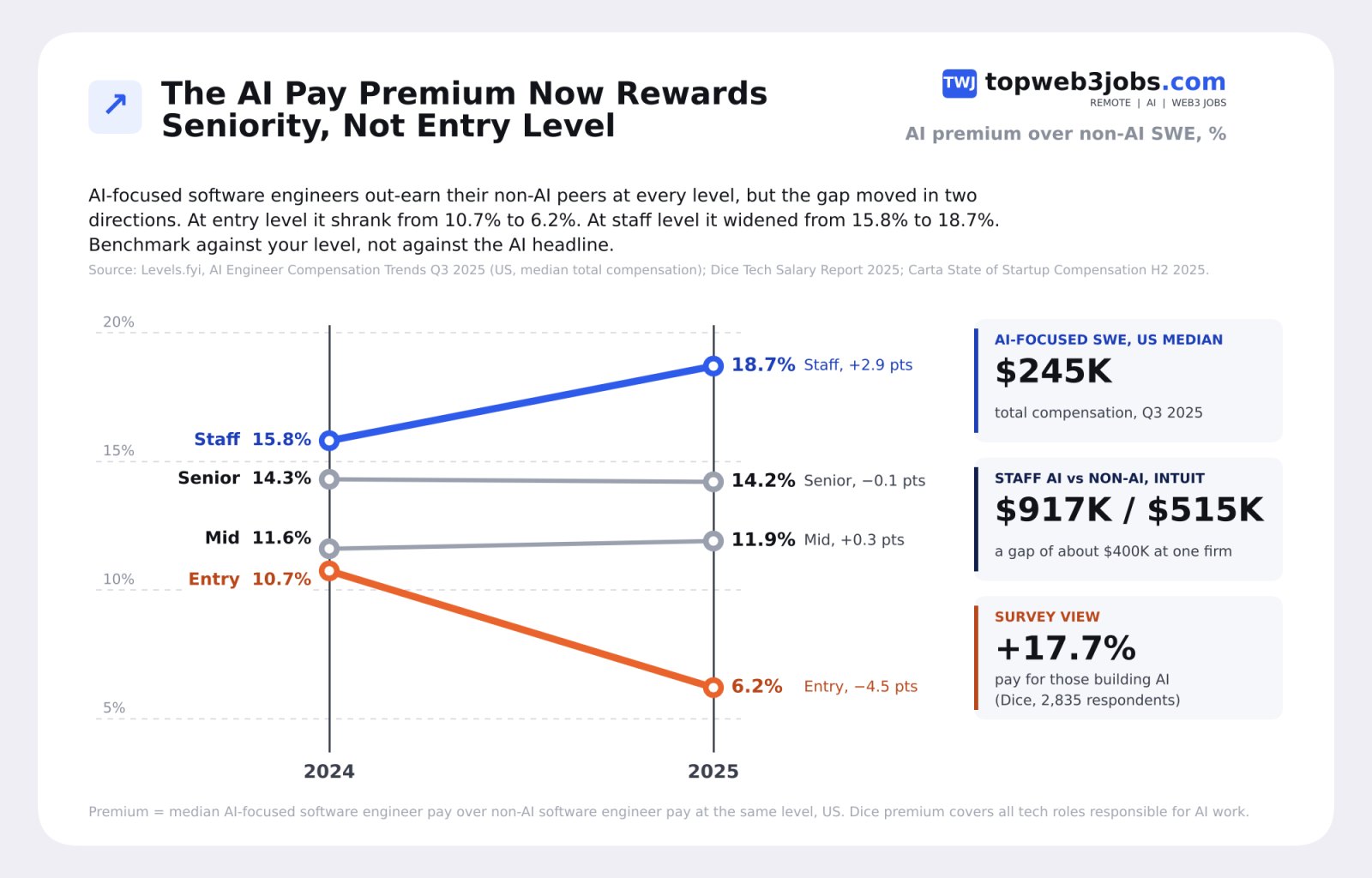
- At US startups, the median AI/ML engineer salary rose 9.1% from January 2024 to February 2026. The median initial equity grant rose 31%, and 64% at startups valued $1 million to $10 million
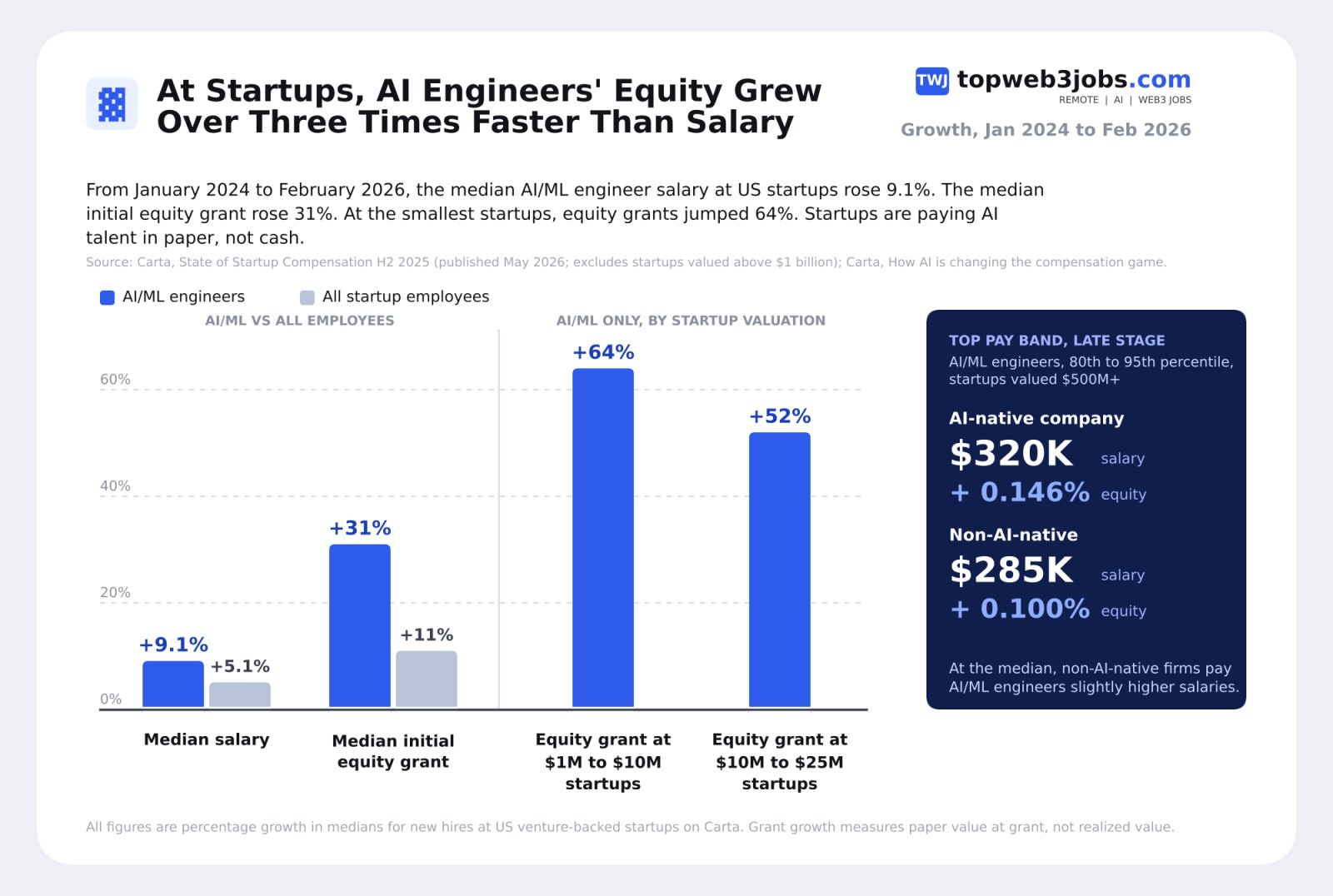
- In 2024, more than 75% of vested startup equity expired without being exercised. Only 33% of in-the-money options were exercised, down from 43% in 2019
- In crypto, 9.6% of employees were paid in crypto by the end of 2024, and 90% of those payments were stablecoins
- Tech workers say they would accept an average 25.6% pay cut for remote or hybrid work, yet in the same study remote roles paid slightly more than identical office roles
Start With the Right Benchmark: Your Level, Not "AI"
Most AI developers benchmark against a headline number. That number is the median, and the median hides the level.
Levels.fyi puts the median total compensation for AI-focused software engineers in the US at $245,000 in Q3 2025. The premium over non-AI engineers is not flat across levels.
At entry level, the AI premium shrank from 10.7% in 2024 to 6.2% in 2025. At mid level it held near 12%. At senior level it stayed around 14%. At staff level it grew from 15.8% to 18.7%.
The gap is widest at the top of the ladder. At Intuit, staff-level AI engineers reported $917,000 in total compensation, against $515,000 for non-AI peers at the same level.
Survey data points the same way. Dice found that professionals responsible for AI work earned 17.7% more than those who were not, across 2,835 respondents.
The first rule of benchmarking follows from this. Find your level first. Then apply the AI premium for that level, not the average one.
Seniority is also what Web3 teams pay for. As our earlier research on GitHub profiles for Web3 recruiters found, developers with two or more years in crypto now write 70% of the code. A long public record is one of the few ways to prove your level before the offer stage.
Separate the Base From the Package
Total compensation mixes cash you will receive with paper you might receive. A clean benchmark splits them.
Carta's data on US venture-backed startups shows the split moving. From January 2024 to February 2026, the median AI/ML engineer salary rose 9.1%. That was close to double the 5.1% rise across all roles.
Equity moved much faster. The median initial equity grant for AI/ML engineers rose 31%, against 11% for all employees. At startups valued $1 million to $10 million, AI/ML equity grants rose 64%. At startups valued $10 million to $25 million, they rose 52%.
The smallest companies have the least cash, so they pay in equity. That is rational for them. It moves risk onto you.
The top of the late-stage market shows the same pattern. At startups valued above $500 million, AI-native companies paid AI/ML engineers in the 80th to 95th percentile a $320,000 salary plus 0.146% equity. Non-AI-native companies paid $285,000 plus 0.1%. At the median, Carta notes, non-AI-native companies actually paid AI/ML engineers slightly higher salaries.
Posted ranges are wide too. In San Francisco job listings, OpenAI lists several software engineering roles at $230,000 to $385,000 a year. A band that wide only becomes useful once you know your level.
Discount the Equity Before You Compare
A grant valued at $200,000 on paper is not $200,000. The data on what employees actually turn into cash is sobering.
Carta reports that in 2024, more than 75% of vested equity held by departing employees expired without being exercised. Most of it was simply left behind when people changed jobs or were laid off.
Even options worth exercising often go unused. In 2019, employees exercised about 43% of their in-the-money options. By 2024, that share had fallen to 33%. Carta points to lower valuations, layoffs and higher interest rates as the main causes.
The 90-day window is a key reason. Many option plans give departing employees only 90 days to pay the exercise price and the tax bill. Many cannot, or will not, write that check.
Crypto compensation follows a different path, but the lesson is similar. Pantera's 2024 survey of about 1,600 crypto workers found that 9.6% were paid in crypto, up from about 3% in 2023. Stablecoins made up 90% of those payments, with USDC at 63% and USDT at 28.6%. Volatile tokens such as SOL and ETH were a small share.
In practice, most crypto workers who take payment on-chain choose dollar-pegged assets. Treat volatile token grants the way you treat startup options: as upside, not salary.
A Simple Way to Compare Two Offers
The method below is a TopWeb3Jobs editorial framework. It is a planning tool, not a valuation model and not financial advice.
Step 1: Fix the base. Compare base salaries directly. This is the only number that arrives every pay period regardless of what the company does next.
Step 2: Annualize the equity. Divide the grant's stated value by the vesting period, usually four years. A $160,000 grant over four years is $40,000 a year on paper.
Step 3: Run three scenarios. Value private equity at zero, at its stated value, and at three times its stated value. If the offer only beats the alternative in the third scenario, you are buying a lottery ticket with your salary.
Step 4: Read the terms. Ask about the exercise window after you leave, the strike price, the latest valuation, and whether the company allows early exercise. For token grants, ask about lockups, the vesting schedule and whether the token is liquid.
| Offer component | How to count it | What to ask |
|---|---|---|
| Base salary | Full value | Is it fixed by location or by role? |
| Public company stock (RSUs) | Close to market value, minus tax | What is the vesting schedule and refresh policy? |
| Private startup options | Zero, 1x and 3x scenarios | Exercise window, strike price, latest valuation |
| Token grants | Zero to stated value, after lockup | Lockup period, liquidity, vesting cliff |
| Stablecoin salary | Full value, like cash | Who pays transfer fees, and in which stablecoin? |
Do Not Discount Yourself for Working Remotely
Remote work changes how many developers negotiate. The data says it should change less than they think.
A study by Zoe Cullen, Bobak Pakzad-Hurson and Ricardo Perez-Truglia, published by the American Economic Association in July 2025, found that tech workers would accept an average 25.6% pay cut for remote or hybrid work. That is three to five times larger than earlier estimates.
The same research found that remote positions paid, on average, slightly more than identical in-office positions in their sample. Many candidates are offering a discount that employers are not asking for.
Remote AI roles also come in very different shapes. Developers browsing AI and machine learning roles will find hourly data-rating contracts listed at $17 to $38 an hour next to salaried annotation roles at $70,000 to $80,000. The category label tells you little. The job title and level tell you most.
What Benchmarks Cannot Tell You
Every number in this article is a median or a survey share. Your offer is a single data point.
Most of the salary data here is from the US. Levels.fyi's 2025 dataset draws heavily on US submissions, and Carta tracks US venture-backed startups. Remote developers paid by US companies from other countries may see different bands.
Startup equity data also excludes the biggest winners. Carta's compensation figures leave out startups valued above $1 billion, where AI pay is likely higher.
Finally, a grant's growth is not its return. A 64% bigger equity grant at a $5 million startup can still be worth nothing if the company does not survive.
What to Watch Next
First, the entry-level squeeze. The AI premium for new engineers fell to 6.2% in one year. If that continues, junior AI developers should benchmark against general software engineering bands, not AI headlines.
Second, longer exercise windows. As more departing employees let options expire, a longer exercise window is becoming one of the most valuable terms a candidate can ask for.
Third, stablecoin payroll. The share of crypto workers paid on-chain roughly tripled in a year, almost all of it in stablecoins. For remote developers working across borders, getting paid in stablecoins may matter more than getting paid in tokens.
The data supports one clear rule today: benchmark the base by level, then discount everything else until the company proves it is worth more.
Sources:
- Levels.fyi, "2025 AI Engineer Compensation Trends" (Q3 2025): $245,000 median, premium by level for 2024 and 2025, Intuit staff comparison; Levels.fyi, 2025 Pay Report; Dice, Tech Salary Report 2025 (2,835 respondents, January 2025): 17.7% AI premium
- Carta, "State of Startup Compensation H2 2025" (May 2026): AI/ML salary and equity grant growth, January 2024 to February 2026; Carta, "How AI is changing the compensation game": late-stage packages; Carta Data, 2024 analyses of employee option exercise and expiry: 75% expired, 33% vs 43% exercise rate
- Pantera Capital, Crypto Compensation Survey 2024, reported by Blockworks: 9.6% paid in crypto, 90% stablecoins, USDC 63%, USDT 28.6%; Cullen, Pakzad-Hurson and Perez-Truglia, American Economic Association research brief (July 9, 2025): 25.6% remote pay cut; TopWeb3Jobs live listings, San Francisco and AI & ML categories (October 2026)