 TopWeb3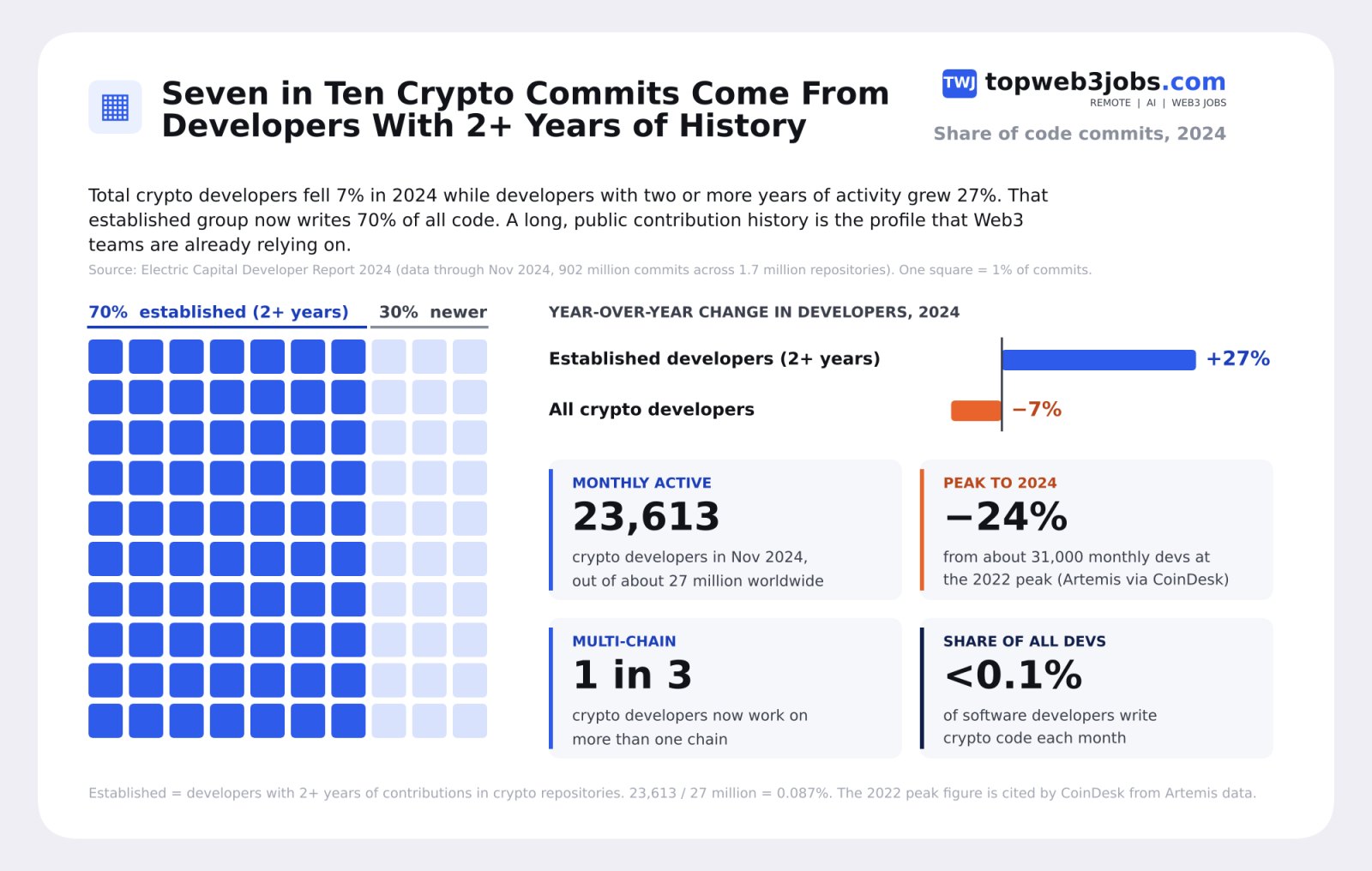
Key Data
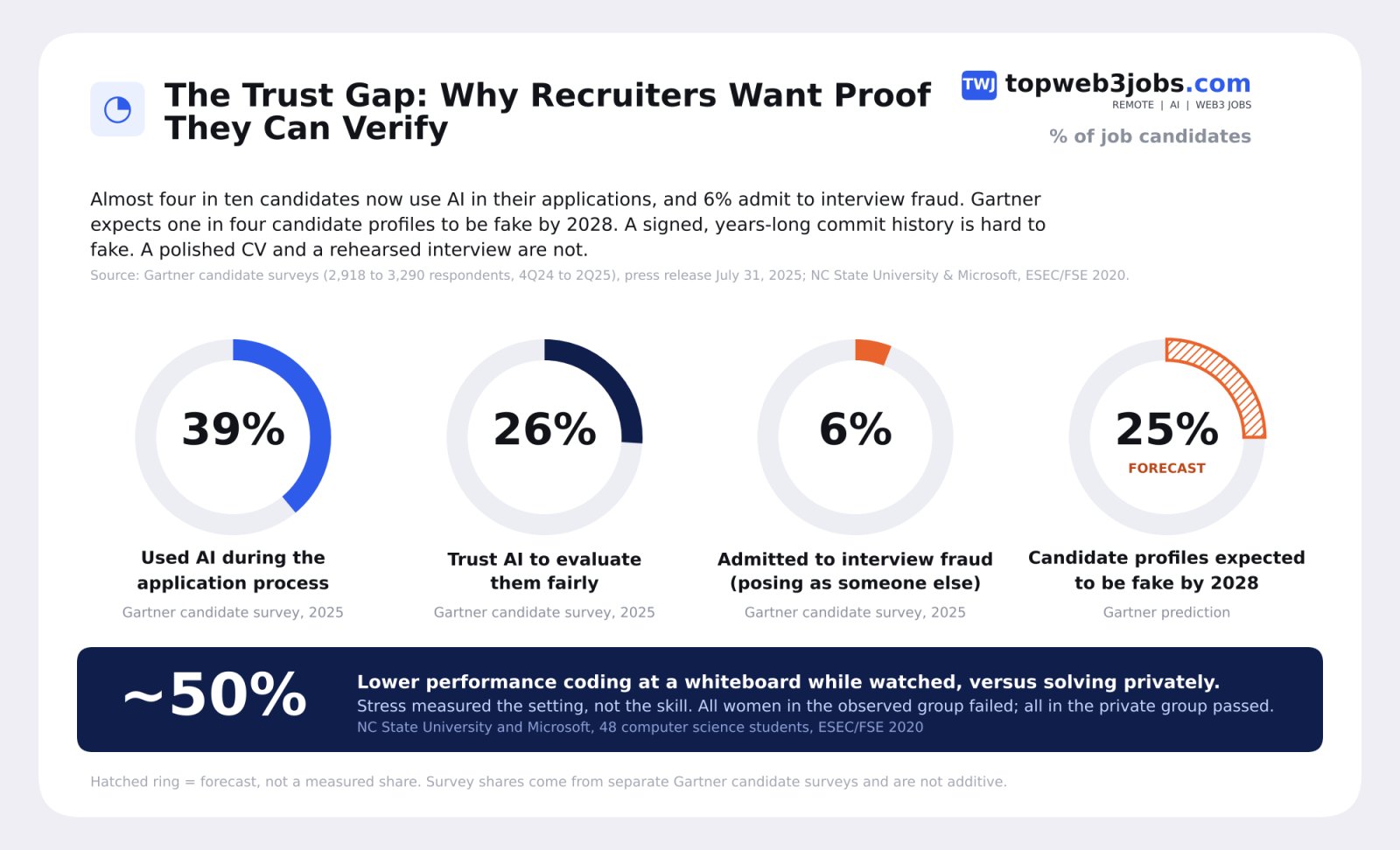
- Crypto had 23,613 monthly active developers in November 2024, out of roughly 27 million software developers worldwide. That is fewer than one in a thousand
- Developers with two or more years in crypto grew 27% in 2024 while the total fell 7%. That established group wrote 70% of all crypto code
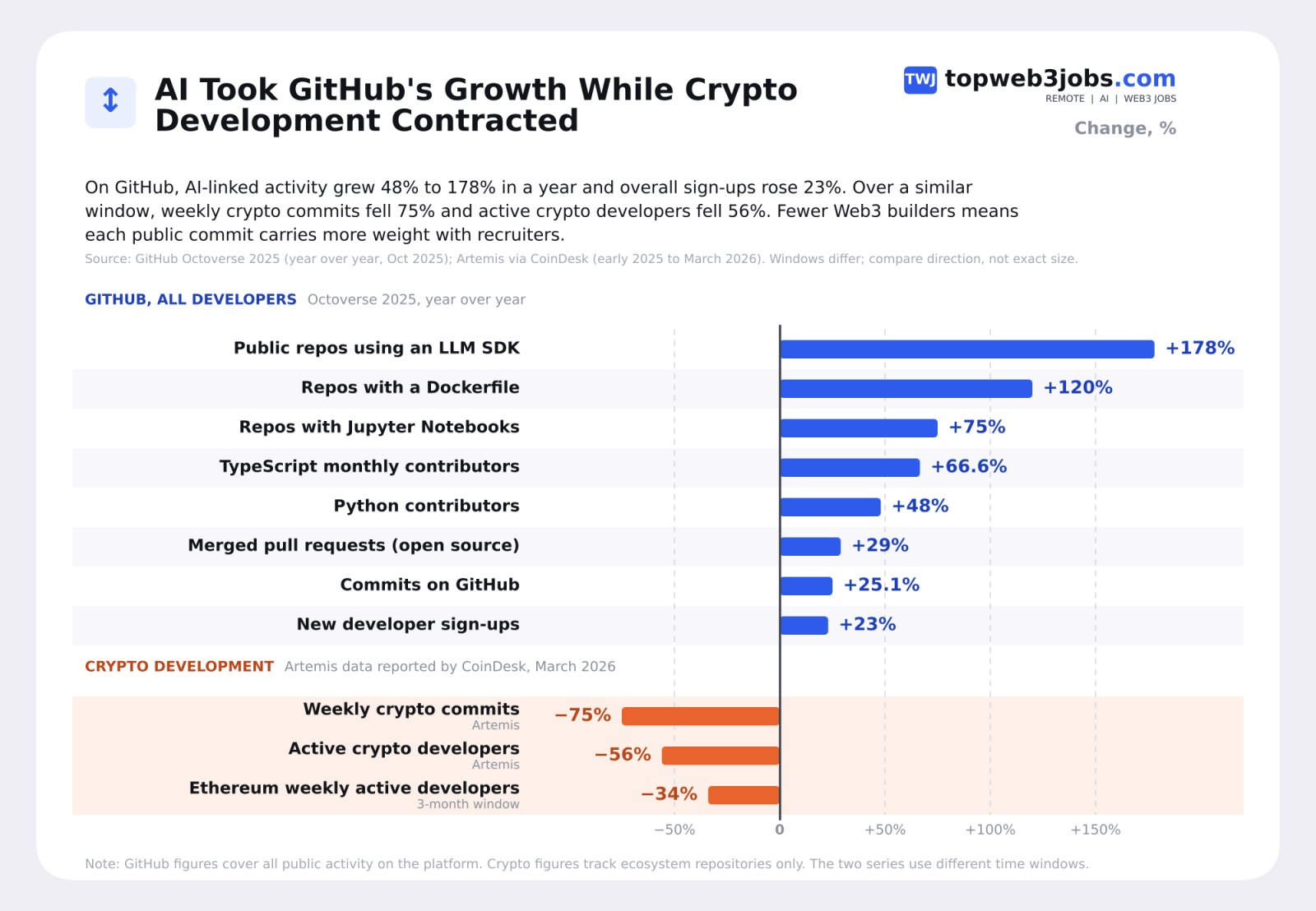
- Artemis data reported by CoinDesk in March 2026 shows weekly crypto commits down about 75%, from 850,000 to 210,000, and active developers down 56% since early 2025
- GitHub grew in the other direction. Octoverse 2025 counts more than 180 million developers, 36 million new sign-ups in a year, and 1.1 million public repositories using an LLM SDK, up 178%
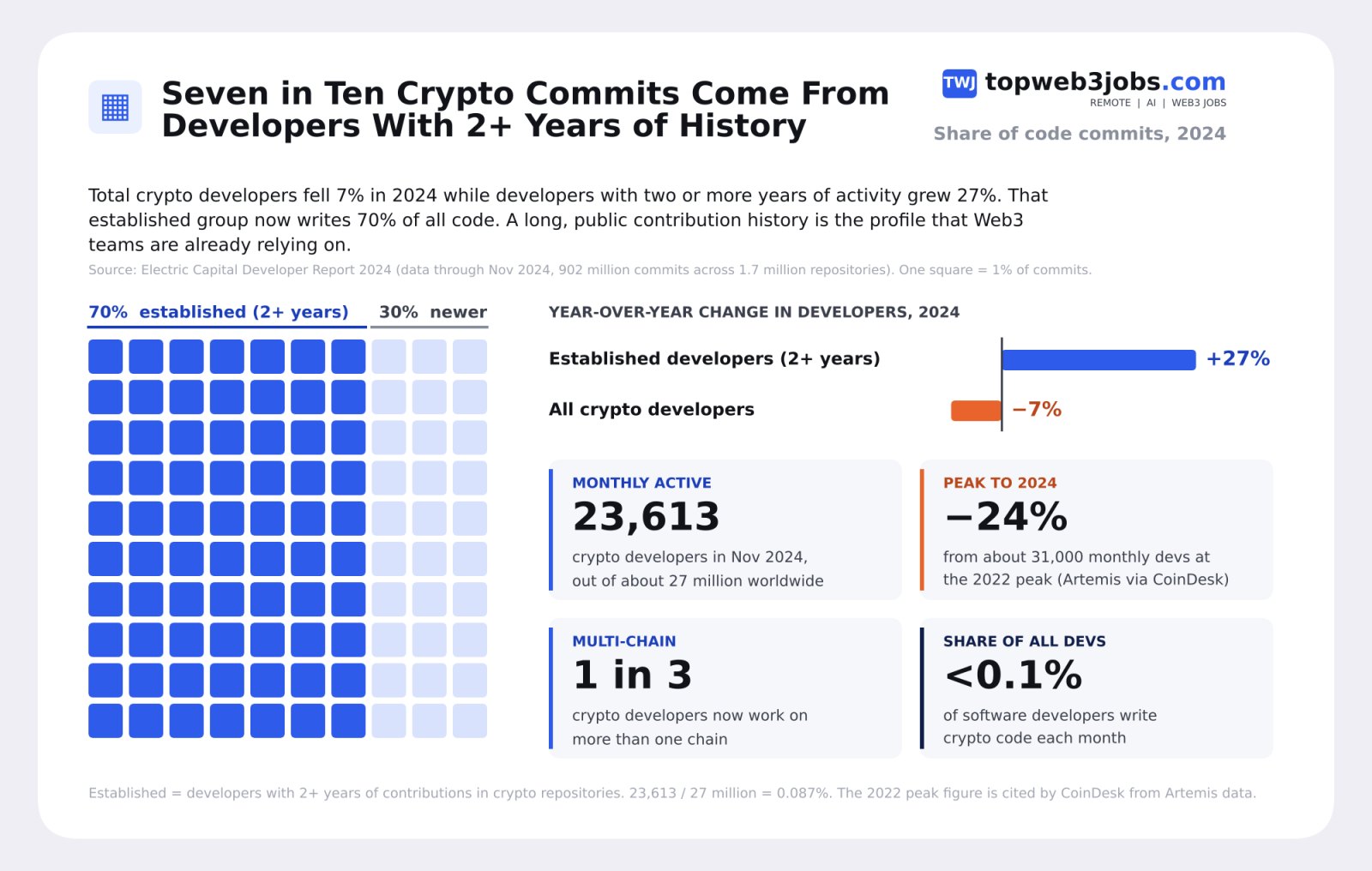
- Gartner found 39% of job candidates used AI in their applications and 6% admitted to interview fraud. It predicts one in four candidate profiles worldwide will be fake by 2028
- In a controlled study, candidates who solved a coding problem at a whiteboard while watched performed about half as well as those who solved it privately
The Web3 Talent Pool Is Small, and Getting Smaller
Crypto is a niche inside software. Electric Capital counted 23,613 monthly active crypto developers in November 2024. The same report puts the global software developer population at about 27 million.
That ratio is 0.087%. For every thousand developers on the planet, fewer than one writes crypto code in a given month.
The pool has also shrunk since then. Artemis data reported by CoinDesk in March 2026 shows weekly crypto commits falling from about 850,000 to 210,000 since early 2025. Active developers fell 56%. Ethereum's weekly active developers dropped 34% in three months, to 2,811.
GitHub as a whole kept growing. Octoverse 2025 recorded 36 million new developers in a year, a 23% jump. Public repositories using an LLM SDK rose 178%. TypeScript became the most used language on the platform, with 2.64 million monthly contributors.
The talent did not disappear. Much of it moved to AI. For a Web3 recruiter, that means fewer candidates, and more of them with mixed AI and blockchain histories.
Who Stayed Is Senior, and Their History Is Public
The 2024 contraction was not even. Total crypto developers fell 7%, but developers with at least two years of activity grew 27%. Electric Capital found this established group wrote 70% of all code commits.
Newcomers carried the losses. CoinDesk, citing the same Artemis data, reports a 58% drop in developers with less than a year in the ecosystem.
This shapes how Web3 teams hire. The people they compete for already have years of commits, merged pull requests and public reviews sitting on GitHub. Recruiters can read that record before they ever book a call.
One in three crypto developers also works across more than one chain. A profile showing EVM and Solana work side by side answers a question that would otherwise take an interview round.
Why the Traditional Interview Is Losing Trust
The case against the classic technical interview is partly old and partly new.
The old part is stress. Researchers at NC State University and Microsoft gave 48 computer science students the same problem in two settings. Those solving it at a whiteboard while watched performed about half as well as those solving it alone. Every woman in the observed group failed. Every woman in the private group passed.
The new part is fraud. Gartner's 2025 candidate surveys found 39% of applicants used AI during the application process. Six percent admitted to interview fraud, either posing as someone else or having someone pose as them. Gartner predicts that by 2028, one in four candidate profiles worldwide will be fake.
Trust runs thin on the other side too. Only 26% of candidates believe AI will evaluate them fairly.
A CV can be generated in seconds. A rehearsed interview can be coached or, in the worst cases, faked. Three years of signed commits, reviewed by strangers and merged into projects you do not control, is much harder to manufacture.
The Contribution Metrics That Do the Screening for You
Not every green square counts. A daily commit streak to your own repository proves little. The metrics below are the ones a recruiter can verify without asking you anything.
The table is a TopWeb3Jobs editorial framework, built from the data above. It is not the output of a survey.
| Metric on your profile | What it proves | Interview step it can replace |
|---|---|---|
| Merged pull requests to repositories you do not own | Your code passed a stranger's review | CV screen and take-home test |
| Code reviews you have written on other people's PRs | Judgment, communication, reading unfamiliar code | Part of the collaboration or system design round |
| Valid findings in public audit contests | Security skill, ranked against other auditors | Solidity or Rust technical screen |
| Tests and CI running in your own repositories | Engineering hygiene | Take-home test |
| Two or more years of steady activity | Staying power, matching the group that writes 70% of crypto code | "Will this person stay?" questions |
| Work across more than one chain or stack | Range, shared by one in three crypto developers | Stack-fit questions |
| Signed commits and linked identities | The profile belongs to you | First layer of the fraud check |
Audit contests deserve a note. Code4rena alone ran 512 audits, logged 26,898 unique findings and surfaced 1,607 high-severity vulnerabilities across more than 16,600 registered wardens. The platform announced in May 2026 that it would wind down its service. Public leaderboard records from contest platforms remain some of the most verifiable evidence a security candidate can show.
How to Optimize Your Profile, Step by Step
- Lead with a proof index. Use your profile README as a one-screen summary. List your five strongest merged pull requests with one line each on what they changed. Recruiters read this before your repositories.
- Pin for the job you want. GitHub lets you pin six repositories. Pin the ones that match the role, such as smart contracts, indexers, ZK circuits or AI agents. Remove tutorial forks.
- Contribute where someone else holds the merge button. A PR merged into a protocol, client or SDK you do not own carries more weight than ten personal projects. GitHub merged 518.7 million open-source pull requests in a year. Make some of them yours.
- Write pull request descriptions like design docs. State the problem, the approach and the trade-offs. A good PR description shows the thinking that interviewers try to pull out of you live.
- Sign your commits. Set up GPG or SSH signing so your commits show the "Verified" badge. Link your profile to your ENS name, personal site and professional accounts. In a market where Gartner expects one in four profiles to be fake, this is cheap insurance.
- Show tests, not just features. Repositories with tests and CI tell a reviewer you ship code that survives. Octoverse 2025 recorded 11.5 billion GitHub Actions minutes in public projects, so the tooling is free and expected.
- Be open about AI assistance. Nearly 80% of new GitHub developers use Copilot in their first week. Recruiters know this. What separates you is the review history showing you understand and can defend the code you merged.
- Link your security record. If you audit, link your contest profiles and top findings from the README. Rank and severity are numbers a hiring manager can check in seconds.
What Contribution Data Cannot Replace
The headline promise needs a limit. No dataset in this article shows Web3 companies dropping interviews entirely.
What the data supports is narrower. A strong public record can replace the early filters, meaning the CV screen, the take-home test and the first technical call. It cannot replace a conversation about scope, salary, team fit and how you handle disagreement.
Public profiles also carry bias. Many strong engineers work in private repositories under NDA. Others lack the free time to contribute after work. A GitHub-first process that ignores this will miss good people.
And a profile is not an ID check. Signed commits prove the same key made the commits. They do not prove who holds the key. Final-stage identity checks will stay, especially for roles with access to treasury or deployment keys.
What Recruiters Will Look For Next
First, verified identity. As AI-generated applications rise, expect more teams to ask candidates to link wallets, signing keys and contest accounts to a single verified profile.
Second, AI and blockchain range. The Linux Foundation's 2025 State of Tech Talent report found 68% of organizations lack enough AI and machine learning skills. Developers who can show smart contract work and LLM integration in the same profile fit the roles that are growing.
Third, review history. As code becomes cheaper to generate, the ability to review it becomes the scarce skill. Public code reviews may become the most read section of a candidate's GitHub.
The data supports one conclusion today: in a market of about 23,000 crypto developers, your public record is your first interview. Make sure it is one you would pass.
Sources:
- Electric Capital, Developer Report 2024 (data through November 2024): 23,613 monthly active developers, 27 million global developers, established developers up 27%, total down 7%, 70% of commits, one in three multi-chain; Artemis data via CoinDesk, "Crypto code commits fall 75% as developers move to AI projects" (March 12, 2026): weekly commits, active developers, Ethereum, newcomers, 2022 peak
- GitHub, Octoverse 2025 (October 28, 2025): 180 million developers, 36 million new, LLM SDK repositories, TypeScript and Python contributors, merged pull requests, commits, Actions minutes, Copilot adoption; Linux Foundation, 2025 State of Tech Talent Report (June 23, 2025): AI and ML skills gap; Code4rena platform statistics and The Crypto Times (May 14, 2026): audits, findings, wardens, wind-down
- Gartner, "Gartner Survey Shows Just 26% of Job Applicants Trust AI Will Fairly Evaluate Them" (July 31, 2025): 39% AI use, 6% interview fraud, one in four fake profiles by 2028; Behroozi et al., "Does Stress Impact Technical Interview Performance?", NC State University and Microsoft, ESEC/FSE 2020