 TopWeb3
Key Data
- Blockchain job postings rose 45% from 2025 to 2026, led by security engineering (+71%), smart contract development (+58%) and protocol design (+52%)
- US AI/ML engineer vacancies rose 94.5% year over year in Q1 2026, from 9,922 to 19,297. AI/ML architect vacancies rose 196.5%
- Total US job postings fell 5.2% over the year to December 2025, and US tech postings sat 34% below pre-pandemic levels
- Only 3% of all US job postings and 4% of US tech postings were fully remote in Q2 2026. Among Web3 job board listings, 78% were fully remote
- Active crypto developers fell 56% from early 2025 to March 2026, and weekly crypto commits fell 75%
- Security hiring is the tightest corner, with three to four open roles for every qualified candidate
Where the 45% Comes From
The 45% figure comes from the crypto.jobs Web3 Job Market Report 2026. It compares blockchain job postings in 2026 with 2025 across a board that currently lists 1,379 active roles at 811 companies.
The growth is uneven. Security engineering postings rose 71%. Smart contract development rose 58%. Protocol design rose 52%. The categories that touch core infrastructure grew fastest.
The wider market went the other way. Indeed Hiring Lab reports that total US job postings were down 5.2% year over year at the end of 2025. US tech postings overall were still 34% below their February 2020 level.
In other words, Web3 and AI hiring grew inside a job market that was shrinking.
AI Hiring Grew Faster Still
The 45% blockchain number is not the biggest surge in the data. AI titles moved faster.
Broadbean's analysis of Veritone's Q1 2026 US vacancy data shows AI/ML engineer openings rising from 9,922 to 19,297, a 94.5% jump. AI/ML architect openings rose from 770 to 2,283. AI product and project manager roles rose from 749 to 1,722.
Not every data role benefited. AI/ML researcher openings grew 19.8% and data scientist openings 8.9%. Big data engineer openings fell 37.5%, from 1,360 to 850.
For total AI vacancies, the report gives counts of 35,445 in Q1 2025 and 55,374 in Q1 2026. Those counts imply growth of about 56%, while the report's text states 36%. Either way, AI hiring grew at or above the 45% blockchain pace.
Indeed's data points the same way. In December 2025, 4.2% of US job postings mentioned AI, a record. AI-mentioning tech postings were 45% above their pre-pandemic level, even as tech postings overall were 34% below it.
Startup hiring confirms the shift. Carta found that AI/ML roles appeared 150% more often among startup hires in Q4 2025 than a year earlier.
Remote Is the Default in Web3 and Rare Everywhere Else
The surge in Web3 postings is almost entirely a remote surge.
Robert Half's Q2 2026 data, built on TalentNeuron job posting records, shows that 87% of all US postings were fully in office. Only 10% were hybrid and 3% fully remote. Tech roles were barely different, at 4% fully remote and 11% hybrid.
Web3 listings run the other way. On crypto.jobs, 87% of roles offer some remote work and 78% are fully remote. Pantera's 2024 survey of more than 1,600 crypto workers found 82% working fully remote.
Our own listings tell a similar story. On TopWeb3Jobs, two in three security and audit openings are open to applicants anywhere, with 16 of 24 current roles marked remote worldwide.
Remote does not mean placeless, though. Many teams still anchor around a few hubs. A look at who is hiring in Singapore right now shows exchanges, wallet providers, custody firms and AI labs recruiting side by side, often for roles that cover the wider Asia-Pacific region.
The Scissors: More Openings, Fewer Builders
The most important number in this story is not the 45%. It is what happened to the people who fill those jobs.
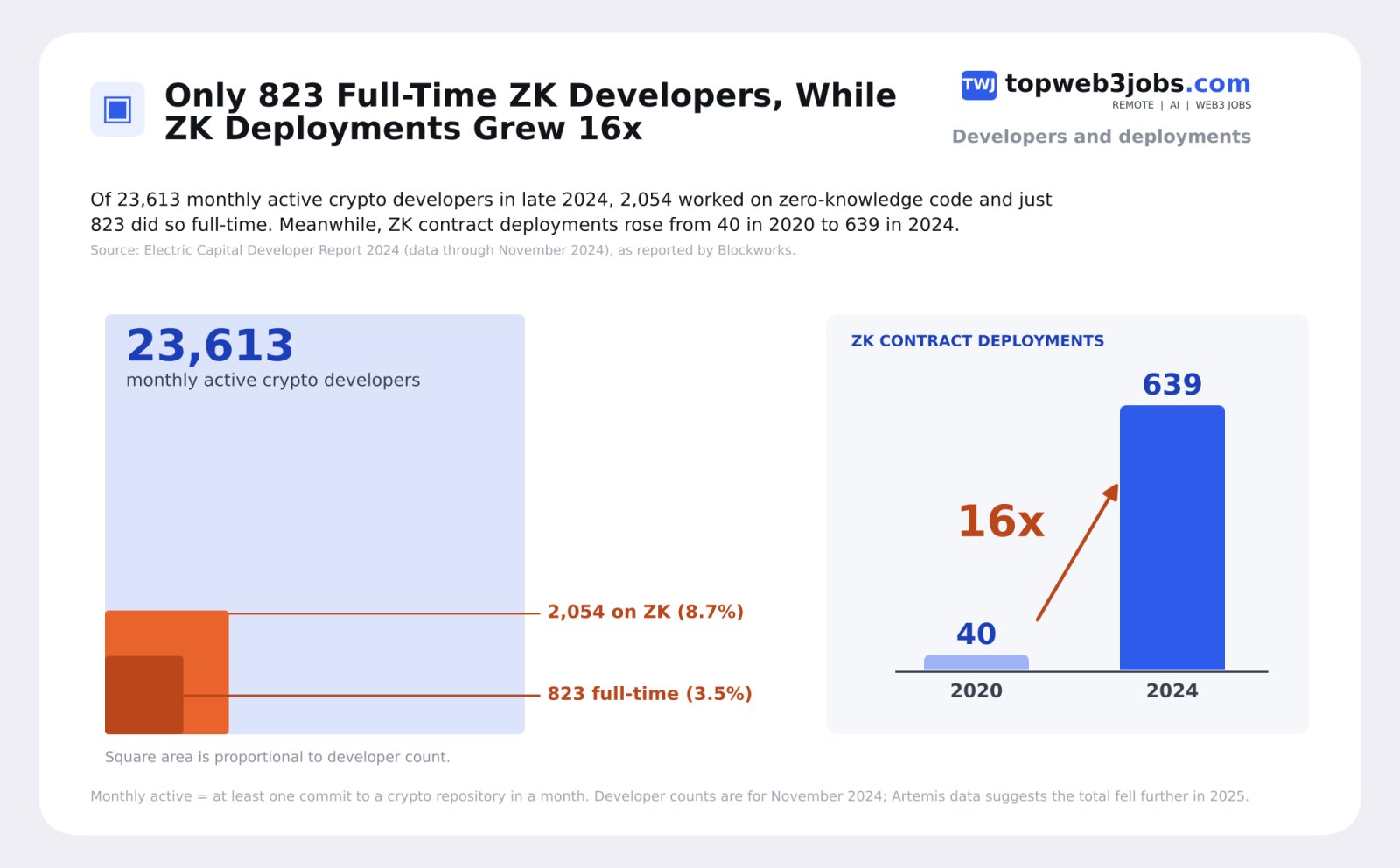
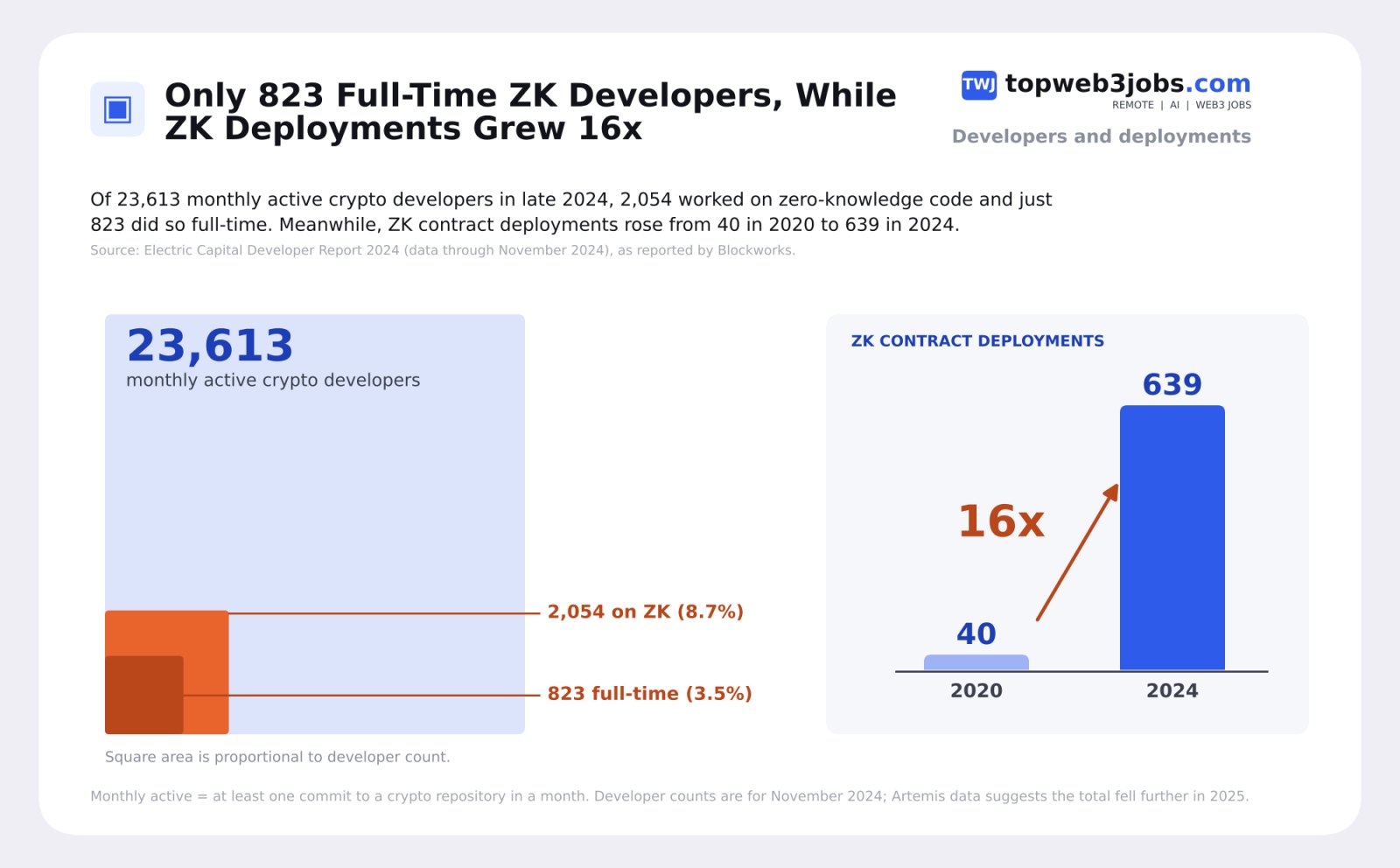
Artemis data reported by CoinDesk in March 2026 shows active crypto developers falling 56% from early 2025. Weekly crypto commits fell 75%, from about 850,000 to 210,000. Developers in their first year in crypto fell 58%.
Put postings and developers on the same base and the gap is stark. If postings are at 145 and active developers at 44, there are roughly 3.3 times as many openings per active developer as a year earlier. This is a derived ratio from two sources, but the direction is clear.
The developers who remain are mostly experienced. That is the same pattern we found when we looked at who still writes most of crypto's code: developers with two or more years in the ecosystem produce about 70% of commits.
Many of the developers who left moved to AI. GitHub's Octoverse 2025 recorded a 178% jump in public repositories using an LLM SDK, over a similar window.
Security Is the Tightest Corner
Security engineering combines the fastest posting growth with the smallest talent pool.
crypto.jobs reports three to four open security positions for every qualified candidate. Security postings rose 71%, faster than any other Web3 category in its data.
The reason is simple. Every protocol that ships new code needs it reviewed, and the number of people who can audit smart contracts at a high level did not grow at anything like 71%.
What This Means for Remote Candidates
The data favors candidates with proof of experience. With fewer active developers and more openings, an engineer with a visible track record has more leverage than at any point since 2022.
Remote work is the norm in Web3, so treat it as a baseline, not a perk. A fully remote role is the standard offer in this sector, not a concession that should cost you salary.
AI skills widen the field. AI-mentioning roles grew while the broader tech market shrank. Engineers who can work across smart contracts and AI tooling fit both of the fastest-growing pools.
Juniors face a harder road. The 58% drop in first-year crypto developers suggests that most of the new openings want experienced hires, not trainees.
Read the Numbers With Care
Job postings are not hires. A posting can stay open for months, be reposted, or never be filled. Growth in postings shows demand, not completed hiring.
The headline 45% comes from a single job board's report, which does not publish its method or comparison window. It should be read as a strong signal, not an industry census.
The AI vacancy data has its own inconsistency, as noted above, between the published counts and the stated growth rate. The title-level figures are internally consistent and are the ones used in our charts.
Finally, the sources cover slightly different periods, from December 2025 to Q2 2026. The comparisons show direction, not precise ratios.
What to Watch Next
First, whether postings turn into hires. If the 3.3x gap between openings and active developers holds, salaries for experienced Web3 engineers should keep rising.
Second, whether developers return from AI. Many builders who left crypto in 2025 kept their skills. A strong market could bring some of them back.
Third, the remote line. US employers are pulling roles back into offices. If Web3 holds at around 80% remote, its job boards will keep drawing applicants from the rest of the tech industry.
The data supports one conclusion today: demand for distributed protocol and AI talent is growing much faster than the supply of people ready to fill it.
Sources:
- crypto.jobs, Web3 Job Market Report 2026: 45% posting growth, security +71%, smart contracts +58%, protocol design +52%, 87% remote and 78% fully remote, 1,379 listings, three to four security roles per qualified candidate; Broadbean, "The State of AI Recruitment in 2026" (June 30, 2026), Veritone Q1 2026 US AI vacancy data
- Indeed Hiring Lab, January 2026 labor market update: 4.2% of postings mentioning AI, postings down 5.2% year over year, tech postings 34% below pre-pandemic; Robert Half, remote job trends, Q2 2026: 3% fully remote overall, 4% in tech
- Artemis data via CoinDesk (March 12, 2026): active developers down 56%, weekly commits down 75%, first-year developers down 58%; Pantera Capital, Blockchain Compensation Survey 2024 (August 2025): 82% fully remote; Carta, State of Startup Compensation H2 2025: AI/ML roles up 150%; GitHub Octoverse 2025: LLM SDK repositories up 178%