 TopWeb3
Key Data
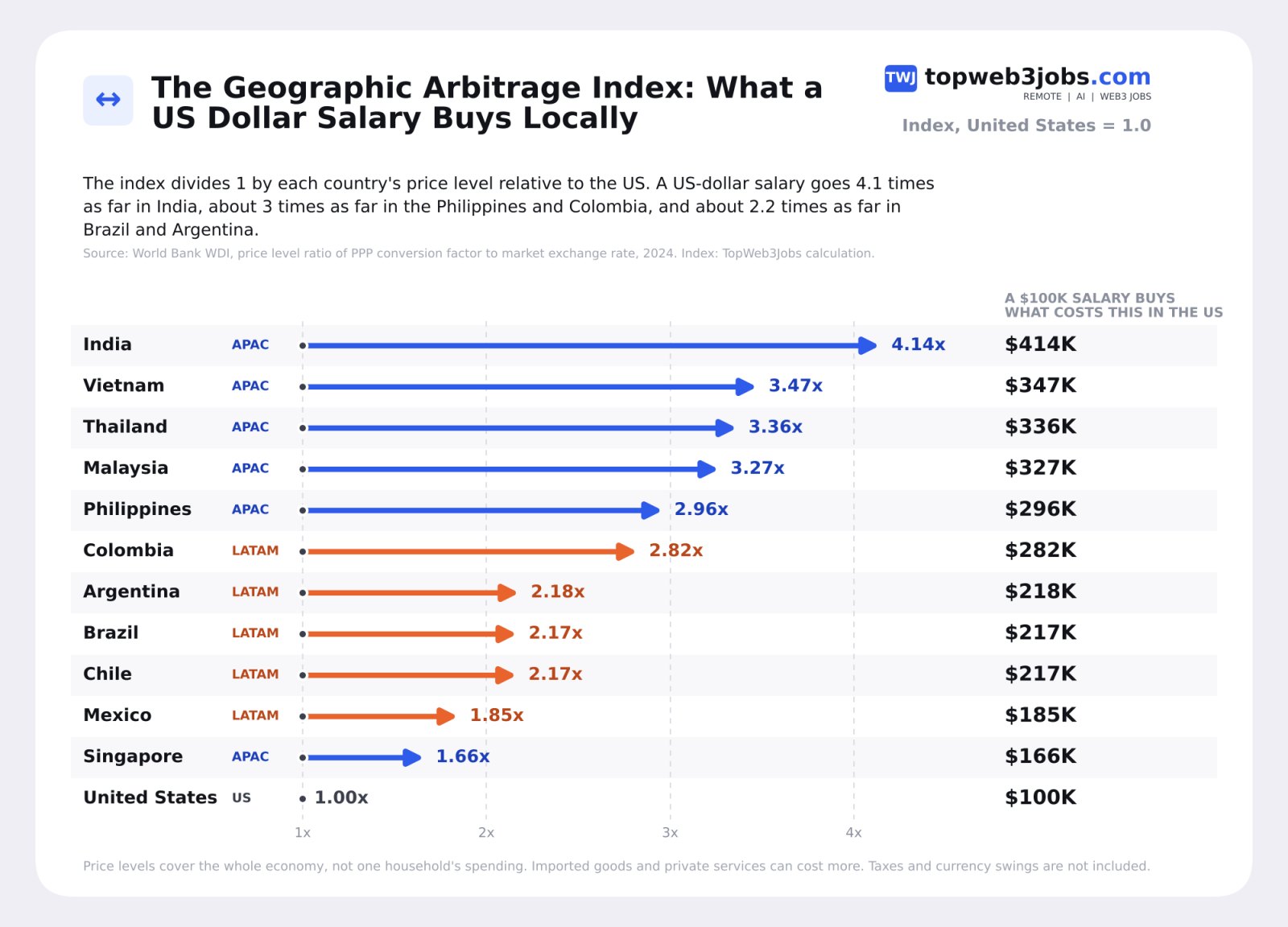
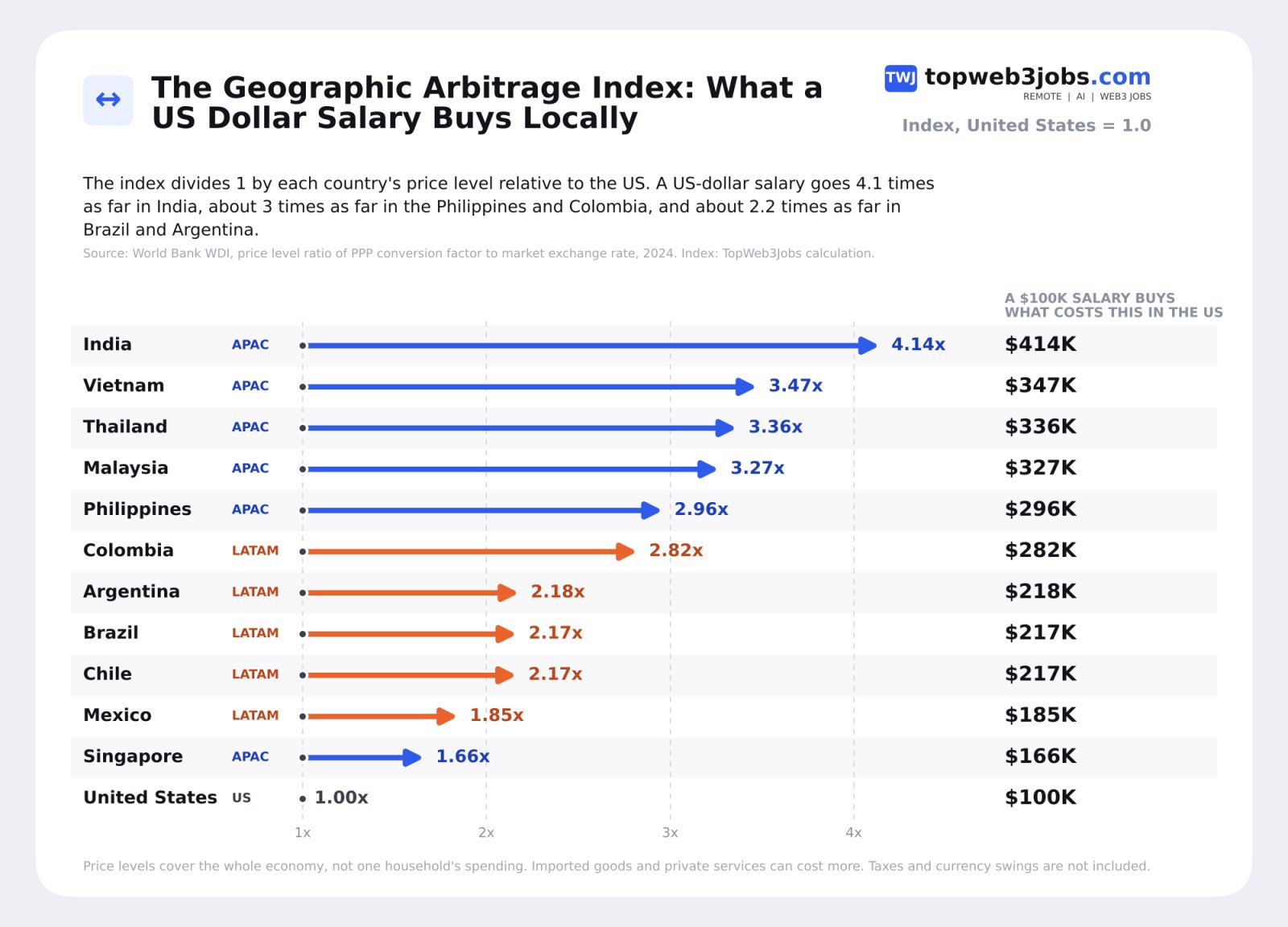
- By World Bank 2024 price levels, a US-dollar salary goes 4.14 times as far in India, 2.96 times in the Philippines, 2.82 times in Colombia and 2.17 times in Brazil
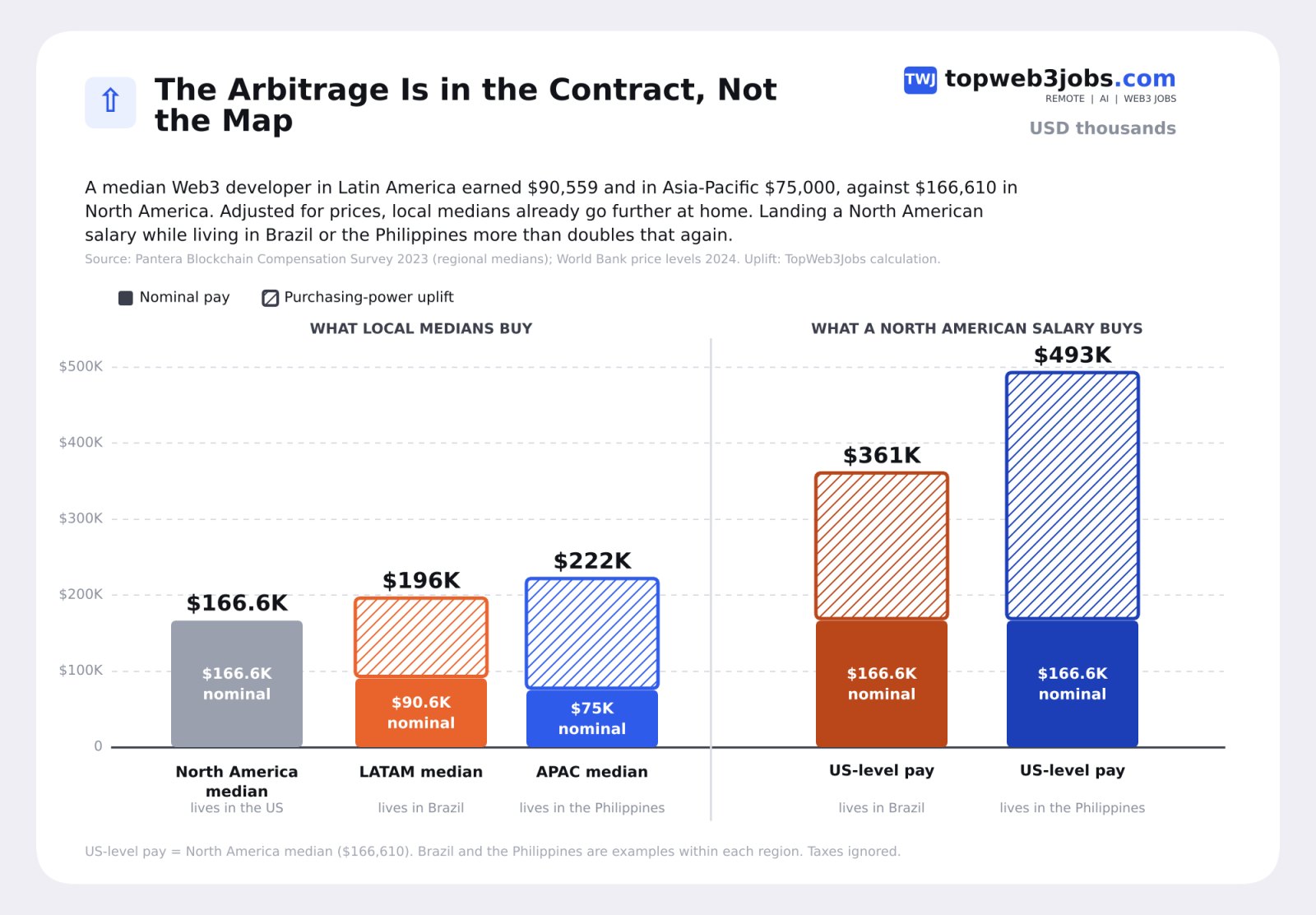
- Pantera's 2023 survey put the median Web3 developer at $166,610 in North America, $90,559 in Latin America and $75,000 in Asia-Pacific
- A North American median salary earned while living in Brazil has the purchasing power of about $361,000 at US prices. In the Philippines it is about $493,000
- 82% of crypto professionals work fully remote, and 72% of Pantera's 2024 respondents were based outside the US
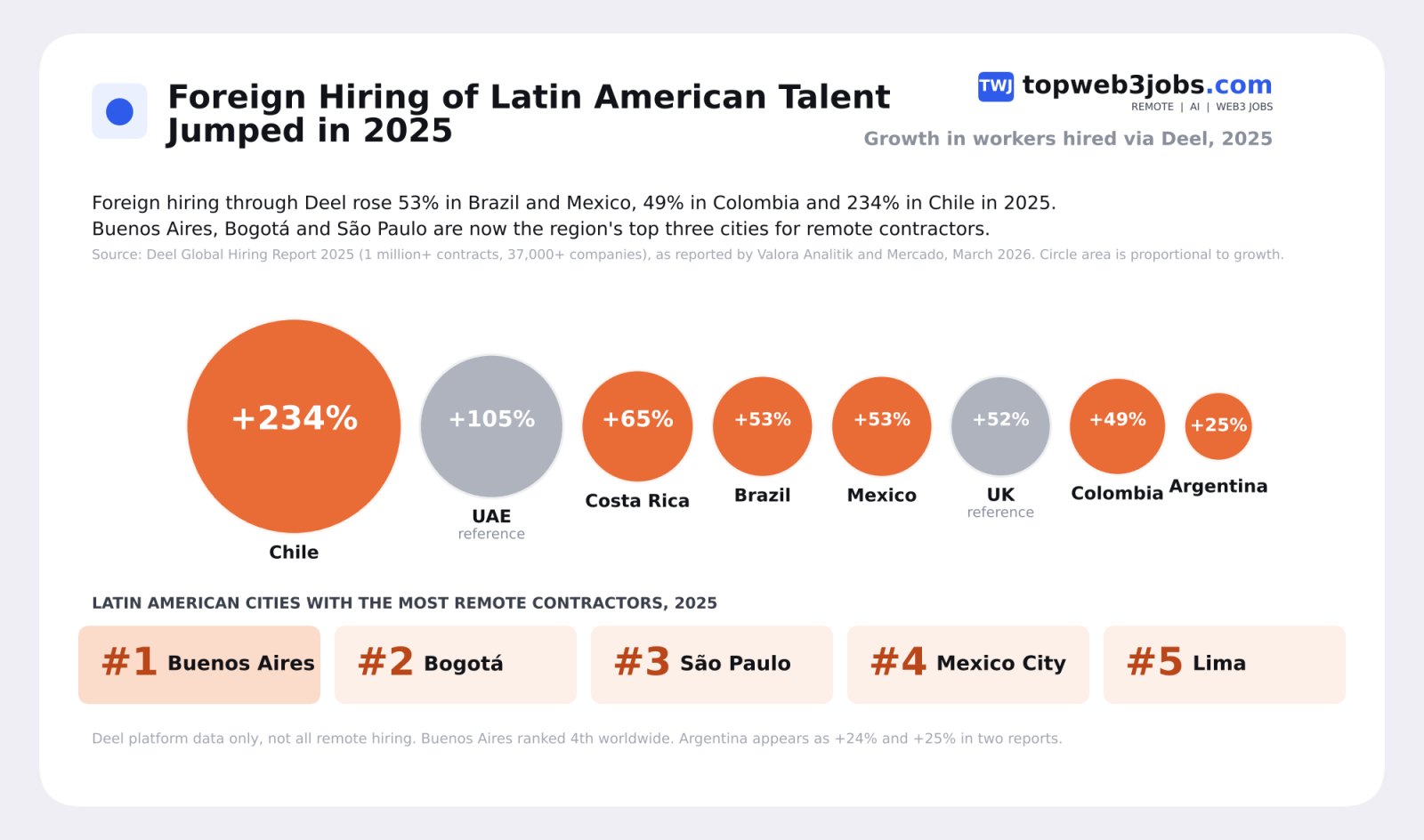
- Foreign hiring through Deel rose 53% in Brazil and Mexico, 49% in Colombia and 234% in Chile in 2025
- Only 4% of US tech job postings were fully remote in Q2 2026, so roles that pay US rates to workers anywhere remain a small pool
Building the Index
The Geographic Arbitrage Index is a TopWeb3Jobs measure. It answers one question: how far does one US dollar of salary go in a given country, compared with the US?
It starts from the World Bank's price level ratio, which compares each country's purchasing power parity rate with its market exchange rate. The US is set at 1.0. We divide 1 by each country's ratio to get the index.
India has the highest score in our sample at 4.14. Vietnam follows at 3.47, Thailand at 3.36, Malaysia at 3.27 and the Philippines at 2.96.
In Latin America, Colombia leads at 2.82. Argentina, Brazil and Chile all sit near 2.17 to 2.18. Mexico scores 1.85. Singapore, one of Asia's most expensive cities, scores 1.66.
Put simply, $100,000 in Colombia buys roughly what $282,000 buys in the US. In Brazil it buys what $217,000 does.
Most Remote Workers Are Not Paid US Rates
The index only helps if the salary is in US dollars at a US level. Most are not.
Pantera's 2023 survey of more than 1,600 crypto workers found a median developer salary of $166,610 in North America. In Latin America the median was $90,559. In Asia-Pacific it was $75,000. The same job in the same industry paid roughly half as much outside North America.
The wider developer market shows the same split. Stack Overflow's 2025 survey puts the median US AI/ML engineer at $189,500 and the global median at $89,427. Our earlier comparison of AI and Web3 pay across six datasets reached the same conclusion: geography moves pay more than specialty.
Many employers price remote roles by location on purpose. In a 2022 WorldatWork survey, 45% of US organizations applied geographic premiums or discounts to pay, and 24% ran separate pay structures for each location.
Where the Arbitrage Actually Comes From
Local medians already go further at home. Adjusted for prices, the Latin American median of $90,559 has the purchasing power of about $196,000 in Brazil. The Asia-Pacific median of $75,000 is worth about $222,000 in the Philippines.
The larger gain comes from the contract. A worker paid the North American median of $166,610 while living in Brazil has the purchasing power of about $361,000 at US prices. In the Philippines, the same salary is worth about $493,000.
That is why the arbitrage is in the contract, not the map. Moving to a cheaper country with a local salary changes little. Keeping a US-level salary while living there changes almost everything.
Why Crypto and AI Startups Are the Best Hunting Ground
Crypto is the most remote-first part of tech. Pantera's 2024 survey found 82% of crypto professionals working fully remote, and 72% of respondents were based outside the US. Teams built that way are more used to hiring across borders.
The wider US market is moving the other way. Robert Half found that only 3% of all US job postings and 4% of tech postings were fully remote in Q2 2026.
Remote does not always mean location-free, even in crypto and AI. Hong Kong is a good example: none of the 24 roles listed there right now is fully remote, and most are hybrid or office-based. In India, much of the hiring by AI and crypto companies also comes with an address. Machine learning work at Cerebras and security seats at MoonPay in Bengaluru are tied to a local office rather than offered at a single global rate.
Demand for Latin American talent is rising fast. Deel's Global Hiring Report 2025, covering more than 1 million contracts at over 37,000 companies, found foreign hiring up 53% in Brazil and Mexico, 49% in Colombia, 65% in Costa Rica and 234% in Chile. Argentina had the most workers hired by foreign companies in the region, and Buenos Aires ranked fourth worldwide among cities with the most remotely hired workers.
How to Capture US-Level Pay From Abroad
The steps below are a TopWeb3Jobs editorial guide built on the data above. They are not tax or legal advice.
Ask how pay is set before you apply. Some companies pay one global rate for a role. Others adjust by country. The answer decides whether the index works for you, so ask the recruiter directly.
Target remote-first employers. Crypto teams, where 82% of staff work fully remote, are more likely to price roles by level rather than location. AI startups with distributed teams follow a similar pattern.
Use time zones as leverage. Latin American workers share most of the US working day. That overlap is a real advantage for US-based teams, and it is worth naming in a negotiation.
Choose how you are paid. Many international remote workers are paid through contractor platforms or employers of record. Some crypto companies pay in stablecoins. Pantera found 9.6% of crypto workers were paid in crypto in 2024, and 90% of those payments were stablecoins such as USDC.
Plan for tax and currency risk. A US-dollar salary protects you from local inflation, but local income tax, social contributions and transfer fees still apply. The index does not include them.
Read the Numbers With Care
The World Bank price level covers the whole economy. A remote professional may spend more on imported goods, private health care or international schooling, which can cost much more than local averages suggest.
Pantera's regional medians are from 2023, and each region covers very different countries. Brazil and the Philippines are used as examples, not as the whole region.
Deel's figures cover hiring through its own platform, not all remote hiring. Argentina's growth is reported as 24% in one account of the report and 25% in another.
Currency moves can change the index quickly. Argentina in particular has seen large swings in its exchange rate.
What to Watch Next
First, location-based pay. If more companies tie remote pay to local markets, the window for US-level salaries abroad will narrow.
Second, Latin American hiring. Growth of 50% or more in several countries in a single year suggests US companies see the region as a long-term talent base, not a short-term cost saving.
Third, stablecoin payroll. As more crypto companies pay in dollar-pegged tokens, workers in high-inflation economies may gain the most from the switch.
The data supports one conclusion today: the biggest pay gain for a remote worker in Latin America or Asia-Pacific is not a cheaper city. It is a US-level contract, and crypto and AI startups are where those contracts are most often found.
Sources:
- World Bank, World Development Indicators: price level ratio of PPP conversion factor (GDP) to market exchange rate, 2024, via Our World in Data; Stack Overflow, Developer Survey 2025: global and US AI/ML engineer medians; WorldatWork, geographic pay survey (May 2022): use of geographic differentials
- Pantera Capital, Blockchain Compensation Survey 2023 (as reported by Cointelegraph, September 2023): regional developer medians; Pantera Capital, Blockchain Compensation Survey 2024 (August 2025): remote share, international respondents, crypto and stablecoin payments; Robert Half, remote job trends Q2 2026
- Deel, Global Hiring Report 2025, as reported by Valora Analitik (March 30, 2026) and Mercado (March 13, 2026): hiring growth by country and top cities for remote contractors; TopWeb3Jobs research and city listings (October 2026)