 TopWeb3
This is a data guide, not tax or legal advice. Rules depend on where the worker lives, where the employer is based and the treaty between them.
Key Data
- Across the OECD, the tax wedge on an average-wage single worker was 35.1% of labour cost in 2025, ranging from 52.5% in Belgium to 0% in Colombia, according to the OECD
- The tax wedge rose in 24 of 38 OECD countries in 2025, fell in 11 and was unchanged in 3
- Employer social security on an average wage runs at roughly 36% of gross pay in France, 21% in Germany, 14% in the UK and 8% in the US, per a compilation of the OECD tables
- EOR list prices run from $199 to $699 per employee per month, with $599 the most common; contractor management costs $29 to $49 a month, and "contractor of record" cover costs $325 to $399
- A US contractor pays 15.3% self-employment tax on 92.35% of net profit, which is $14,130 on $100,000, against $7,650 for the equivalent employee share
- Published estimates for when an own entity beats an EOR range from 5 to 62 employees in one country, with most clustering between 6 and 30
- 72.9 million Americans did independent work in 2025, and a record 5.6 million of them earned more than $100,000
The Three Structures in Plain Terms
A contractor is paid on an invoice. The client withholds nothing in most cases, and the worker handles their own income tax and social security. It is the cheapest and fastest option for the company, and the one that carries the most classification risk.
An Employer of Record is a third party that becomes the legal employer in the worker's country. It runs payroll, pays the local employer contributions and issues a local employment contract, while the client directs the daily work. The client pays salary, contributions and a platform fee.
A local entity is the company's own subsidiary or branch in the worker's country. It carries the most setup work and fixed cost, and gives the most control once the team in that country is large enough.
The choice is not only about cost. Each structure moves tax and risk between the company and the worker, and the right one depends on how many people sit in each country and how long they will stay.
Why the Country Matters More Than the Label
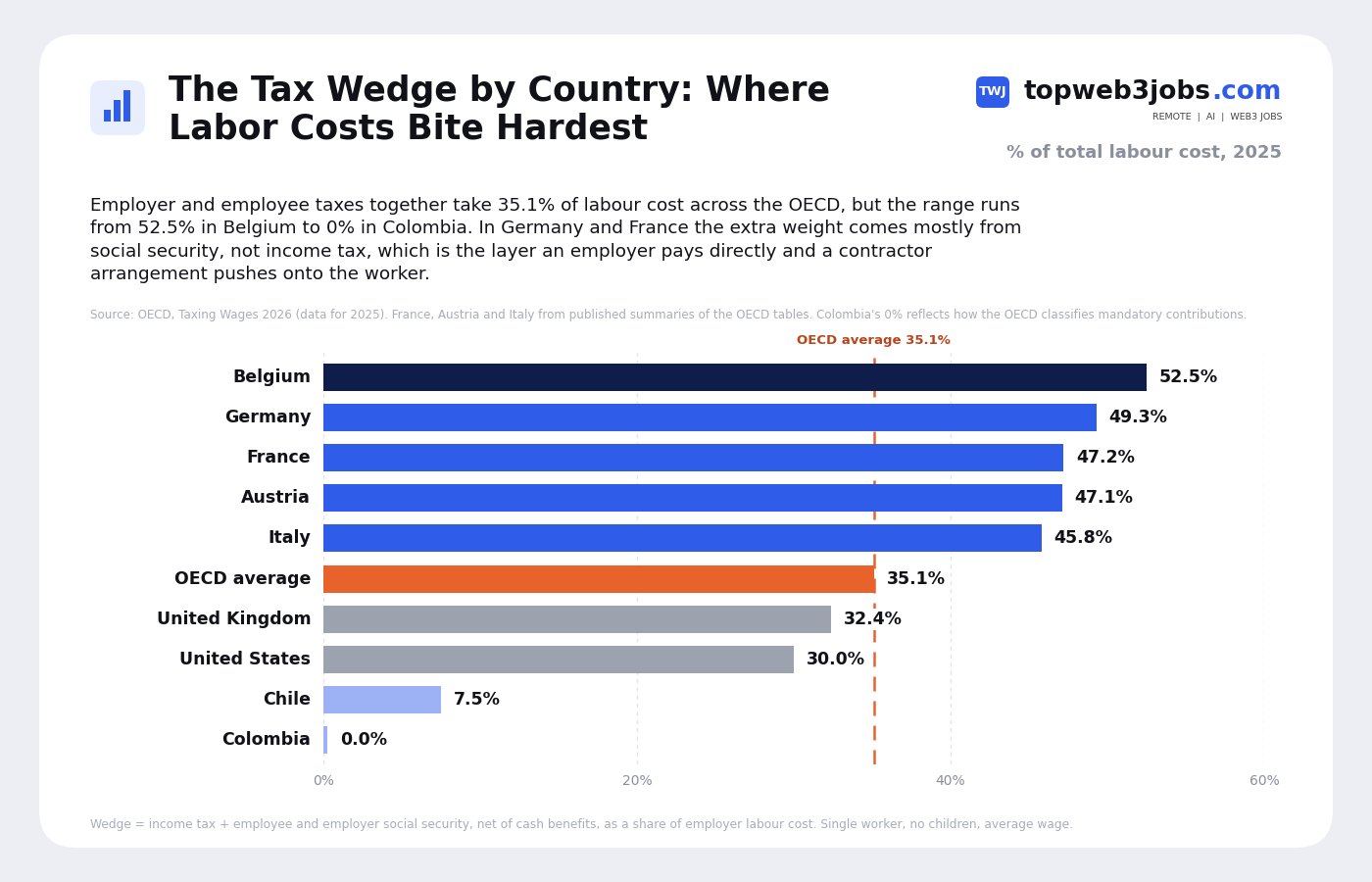
Before comparing structures, it helps to see how differently countries tax labour.
The OECD's Taxing Wages 2026 report measures the tax wedge: income tax plus employee and employer social security, net of cash benefits, as a share of what the employer pays in total. For a single worker on the average wage, the OECD average was 35.1% in 2025. Belgium topped the list at 52.5%, with Germany at 49.3%, France at 47.2%, Austria at 47.1% and Italy at 45.8%. The UK came in at 32.4% and the US at 30.0%. At the bottom, Chile sat at 7.5% and Colombia at 0%, though the OECD notes that Colombia's figure reflects how it classifies mandatory pension and health contributions rather than a tax-free system.
The pattern is useful because social security, not income tax, drives most of the gap. Germany's income tax on an average wage is close to the OECD average, yet its wedge is the second highest because employee and employer contributions together exceed 42% of gross pay. In France the employer alone pays about 36% of gross wages in contributions before the worker sees a euro.
That is the layer an EOR or entity pays directly and a contractor arrangement leaves with the worker.
What the Employer Pays: Contractor vs. EOR
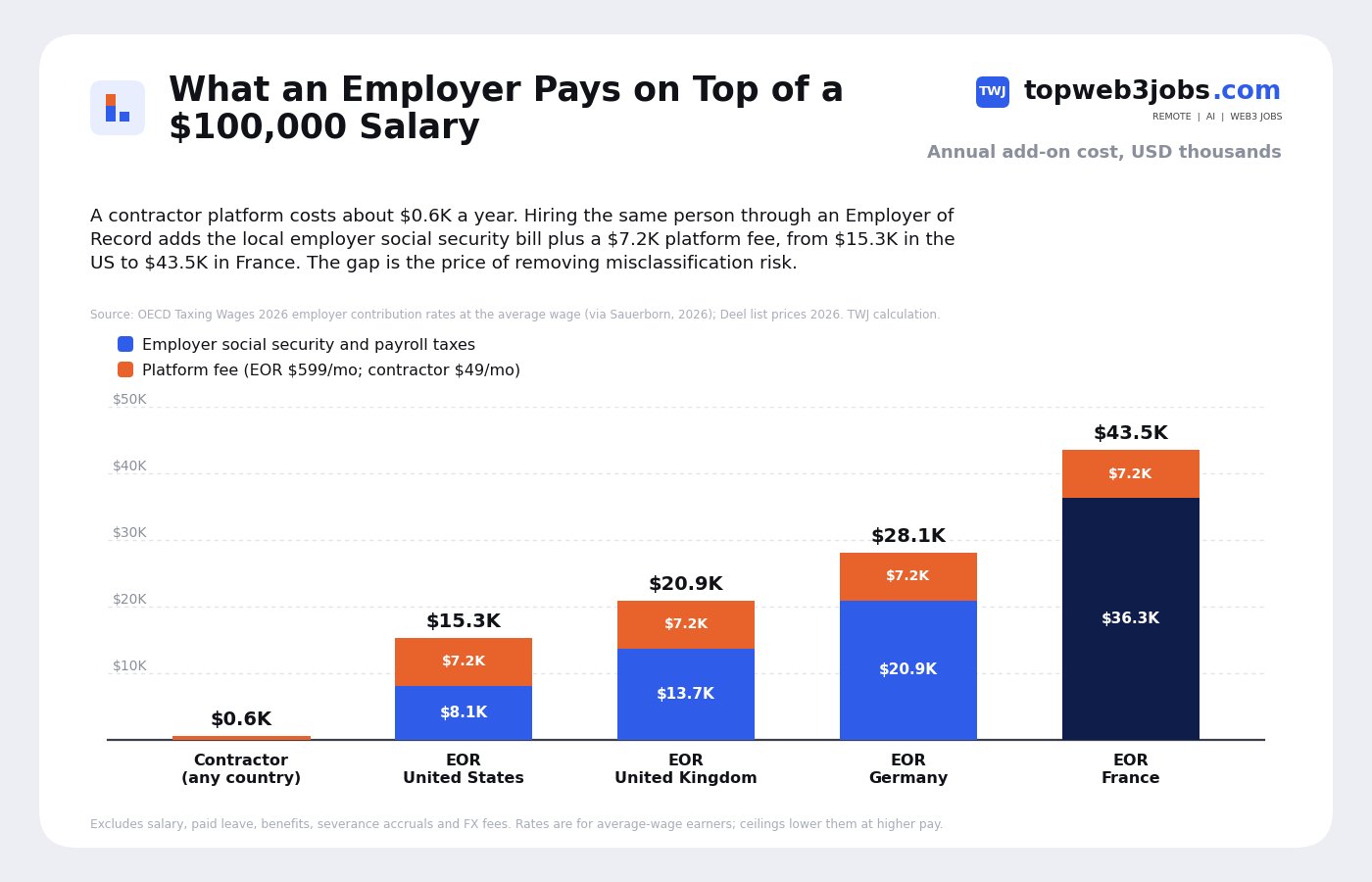
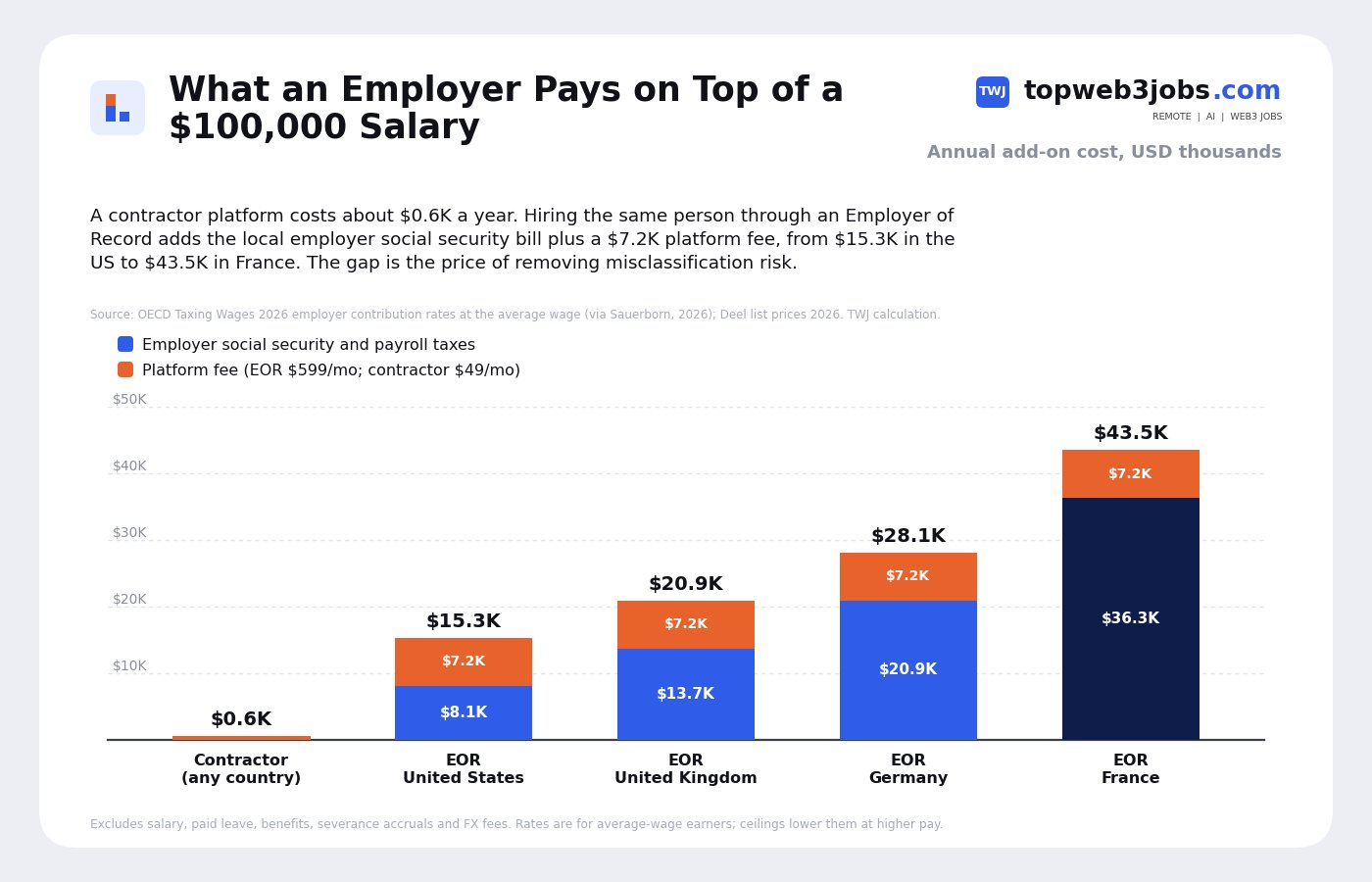
The cost gap between a contractor and an EOR hire is mostly the employer contribution bill plus the platform fee.
Using Deel's published prices, contractor management costs $49 a month, or $588 a year. An EOR costs $599 a month, or $7,188 a year, before any employer contributions. Other providers sit in a similar band. Remote and Oyster list $699 a month, Multiplier lists $400 to $459 and budget providers start at $199. A September 2026 review of 14 provider pricing pages found $599 the most common list price.
Add the employer contributions at average-wage rates and the totals diverge fast. On a $100,000 salary, an EOR hire adds about $15,300 a year in the US, $20,900 in the UK, $28,100 in Germany and $43,500 in France. The contractor route adds about $600.
Two caveats apply. Contribution rates are lower at higher salaries in countries with ceilings, such as Germany and France, so a senior engineer can cost less than the average-wage rate suggests. And an EOR fee is often a small share of the total in high-cost countries. One EOR guide puts it at roughly 5% to 7% of total cost in France but 10% to 15% in India, where employer contributions are lighter.
Platform fees are not the only extras. Foreign exchange markups of 1% to 3% can add $1,000 to $3,000 a year on a $100,000 salary, and some providers hold a deposit of one to two months of salary.
What the Worker Pays: The Hidden Side of the Contractor Route
A contractor looks cheaper to the company because some of the cost moves to the worker.
In the US, a self-employed worker pays both halves of Social Security and Medicare. The rate is 15.3%, made up of 12.4% for Social Security up to a 2026 cap of $184,500 and 2.9% for Medicare with no cap, applied to 92.35% of net earnings. On $100,000 of net profit that comes to $14,130. A W-2 employee on the same pay would pay $7,650 through payroll. The gap of about $6,480 is partly offset because half of the self-employment tax is deductible when calculating income tax.
Contractors also give up protections that come with employment, including paid leave, employer pension contributions, unemployment cover and severance, depending on the country. For a worker in a high-wedge country, the contractor route can look attractive on take-home pay and still leave them with weaker cover.
The independent workforce is large enough that many workers choose this on purpose. MBO Partners' 2025 study counted 72.9 million independent workers in the US, including 27.6 million full-time, and a record 5.6 million earning above $100,000. Choosing independence is legitimate. The problem starts when someone who works like an employee is paid like a contractor.
The Risks That Cut the Other Way
Cheap contractor routes carry two distinct risks for the company.
Misclassification. If a tax authority decides a contractor is really an employee, the company can owe back taxes, contributions, interest and penalties. A 2024 survey of 400 US executives by Solar Staff found potential penalties of up to $25,000 per worker were a concern for 66% of respondents, though the survey came from a payments vendor. Contractor-of-record products, priced at $325 to $399 a month, exist to take on this liability, and they cost far more than a basic contractor platform.
Permanent establishment. A remote worker's home can, in some cases, create a taxable presence for the employer in the worker's country. The OECD's November 2025 update to its Model Tax Convention commentary says a home office is not automatically a permanent establishment, and introduces a two-part test built around how much time is spent there and whether there is a commercial reason for the arrangement. Commentary from tax firms points to a rough 50% working-time indicator, and a Dutch policy decree published in 2026 follows it. The OECD also said that allowing remote work only to keep an employee or cut office costs does not count as a commercial reason. Notably, the guidance applies to employees and contractors alike, so switching the label does not remove the question.
An EOR removes the first risk, because the worker is a genuine local employee, and reduces the second by putting a local employer on the ground. That is much of what the fee buys.
When an Own Entity Beats an EOR
An EOR charges per head. An entity charges mostly up front and per year. At some headcount in one country, the second becomes cheaper.
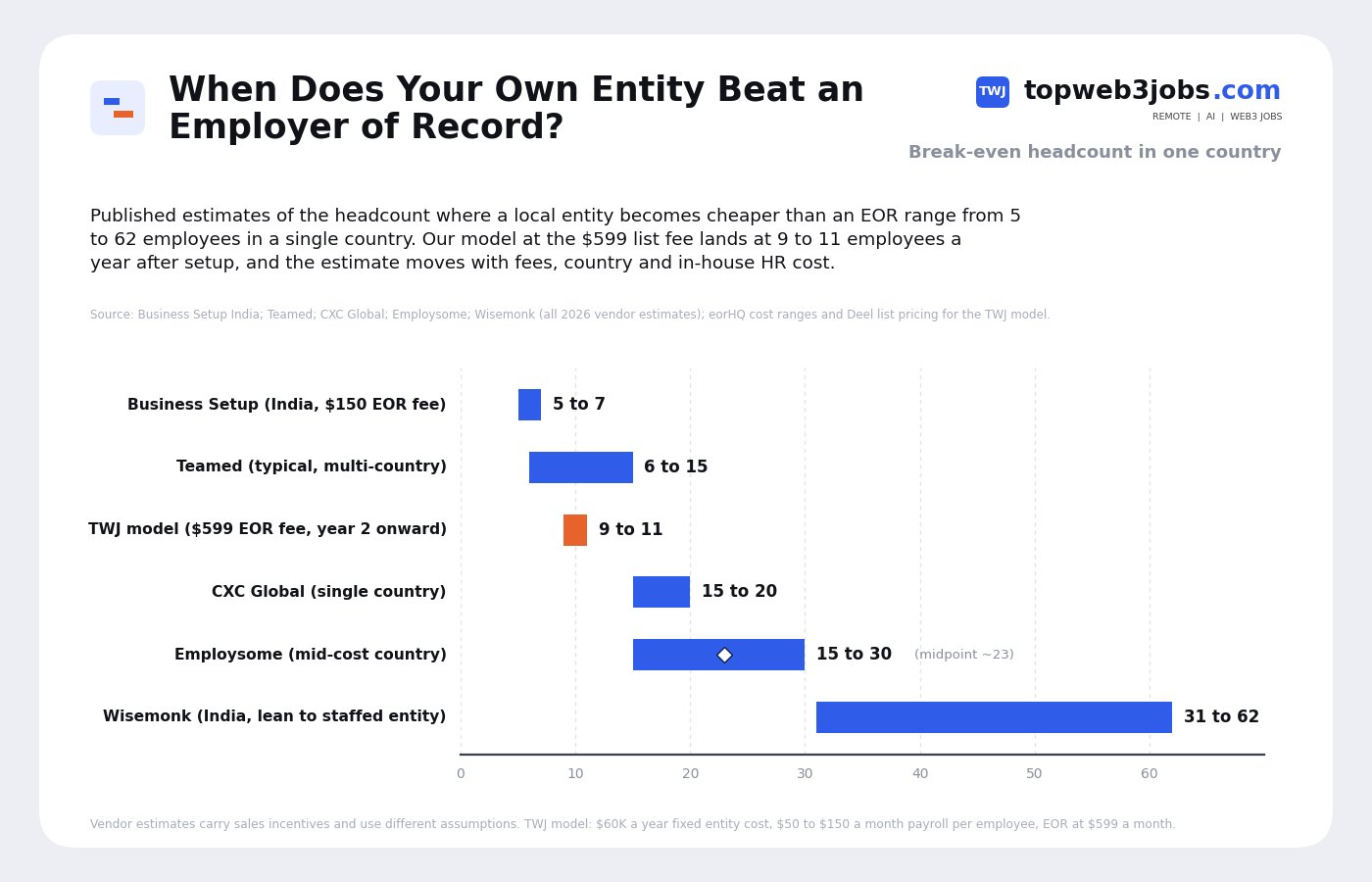
Published break-even estimates are wide. Business Setup puts the point at about 5 to 7 employees in India at a $150 EOR fee. Teamed says 6 to 15 in a single country. CXC Global says 15 to 20. Employsome says 15 to 30, with a midpoint near 23. Wisemonk puts India at 31 to 62, depending on whether HR and finance are staffed in-house. The spread comes from different assumptions about fees, country complexity and how the fixed costs are counted.
We ran a simple model with eorHQ's published ranges. An entity costs roughly $15,000 to $50,000 to set up and $36,000 to $96,000 a year to maintain. Using the midpoint of $60,000 a year, payroll costs of $50 to $150 per employee per month and a $599 EOR fee, the entity wins from about 9 to 11 employees once setup is paid for. Counting a $30,000 setup in year one pushes that to roughly 14 to 17.
Some providers say distributed teams of one or two people per country usually stay on EOR, because the fixed costs of an entity do not spread across so few people. For a decentralized team with a handful of people in each of many countries, that is the common case.
How to Choose Your Structure
The steps below are a TopWeb3Jobs editorial guide based on the data above.
Start with how the work is actually done. If the person has set hours, one client, company equipment and a manager, treat them as an employee. A contractor label on that kind of work is the pattern that triggers misclassification claims.
Use contractors for real project work. Independent specialists with several clients, their own tools and control over how they deliver are a fit for the $29 to $49 a month contractor route. Keep contracts specific about deliverables and ownership of the work.
Use an EOR for single hires in new countries. At one to five people per country, the $599 fee is usually lower than running an entity, and it removes most classification risk.
Model the entity once a country passes roughly 10 people. Run your own numbers with the fee, setup cost and in-house HR time included. Do not rely on any single vendor's break-even claim.
Read the EOR quote line by line. A good quote shows gross salary, employer contributions at cost and the provider's fee separately. Bundled all-in rates with no breakdown make comparison hard.
Check the worker's side too. For workers, ask which social security system they will be in, whether a treaty prevents paying twice and what cover they lose as a contractor. A higher headline rate can still be the better deal.
Write down the commercial reason for remote work. Under the OECD's updated commentary, a documented business reason for where someone works helps separate a real taxable presence from a convenience arrangement.
Read the Numbers With Care
The OECD wedge figures are for a single worker without children on the average wage in each country. Workers on higher or lower pay, or with families, will see different results. France, Austria and Italy are taken from published summaries of the OECD tables, and Colombia's 0% reflects classification of its contributions.
Employer contribution rates come from a compilation of OECD data at the average wage. Real rates depend on the salary, the contribution ceilings, the sector and any relief. Our chart also leaves out paid leave, benefits and severance accruals, all of which raise the true cost of an employee.
EOR and contractor prices are published list prices. Providers negotiate at volume, and fees vary by country. Deel is used as the benchmark because it is the most widely quoted.
Break-even headcounts come from vendors who sell either EOR or entity services, and they use different assumptions. Our own model is a simplification, not a quote.
The Solar Staff misclassification figures come from a vendor survey of 400 US executives and describe attitudes, not the share of companies actually penalized.
What to Watch Next
First, the OECD follow-up work on remote working. The November 2025 update left questions on tax residency and social security open, and further guidance is expected.
Second, tax wedges. They rose in 24 of 38 OECD countries in 2025, mostly because wages grew faster than tax thresholds. If that continues, the gap between contractor and employee cost in high-wedge countries will widen.
Third, EOR pricing. List prices already range from $199 to $699, and low-cost providers are pushing the market down. Lower fees pull the entity break-even point higher.
The data supports one clear conclusion today: for most decentralized teams, a mix works best, with genuine independents as contractors, single hires in new countries on an EOR and a local entity only where a country's headcount justifies the fixed cost. The cheapest line on the invoice is rarely the cheapest structure once classification and tax exposure are counted.
Sources:
- OECD, Taxing Wages 2026 (April 2026): tax wedge, income tax and social security by country; OECD Model Tax Convention update on remote work and permanent establishment (November 2025), as summarized by Aird & Berlis, Bennett Jones, PwC Estonia, Prime Global and Mondaq (2026)
- Deel, Remote.com, Oyster, Multiplier and Remofirst published pricing (2026), as compiled by Pin, Second Talent (September 26, 2026) and Casrai; eorHQ, "What EOR Actually Costs in 2026"; Stealth Agents EOR research (2026)
- Seb Sauerborn, "Employment Tax by Country in 2026"; Tax Foundation, "Tax Burden on Labor in Europe, 2026"; MBO Partners by Beeline, 2025 State of Independence (September 2025); IRS and Social Security Administration 2026 FICA and self-employment tax rules; Solar Staff survey via Business Wire (February 2024)
- Teamed, CXC Global, Employsome, Business Setup and Wisemonk EOR-versus-entity break-even analyses (2026)