 TopWeb3

Key Data
- Smart contract developers average about $125,000 on web3.career, with listings from $60,000 to $250,000. ZipRecruiter shows a median of $130,400 and a 90th percentile of $157,000
- Pantera's 2024 survey put median crypto engineering base pay at $148,021 for early-career, $176,000 for mid-level and $202,500 for senior engineers
- US machine learning engineers have a median base of about $200,000 and median total compensation of about $280,000 on Levels.fyi
- Mid-level Web3 roles that require AI skills have a $115,000 median, against $95,000 for other mid-level roles, a 21.1% premium
- AI skills now appear in 53.1% of Web3 job posts, up from 23% a year earlier
- PwC puts the average wage premium for AI skills at 62% across 27 countries, up from 57% a year earlier
Defining the $215K Baseline
There is no official salary for a hybrid Web3-AI developer. Titles vary, and many employers still post these roles under "smart contract engineer," "AI engineer" or plain "software engineer." The $215K baseline in this report is a TopWeb3Jobs framing for the base pay of a senior engineer who works across smart contracts and agent systems at a funded team.
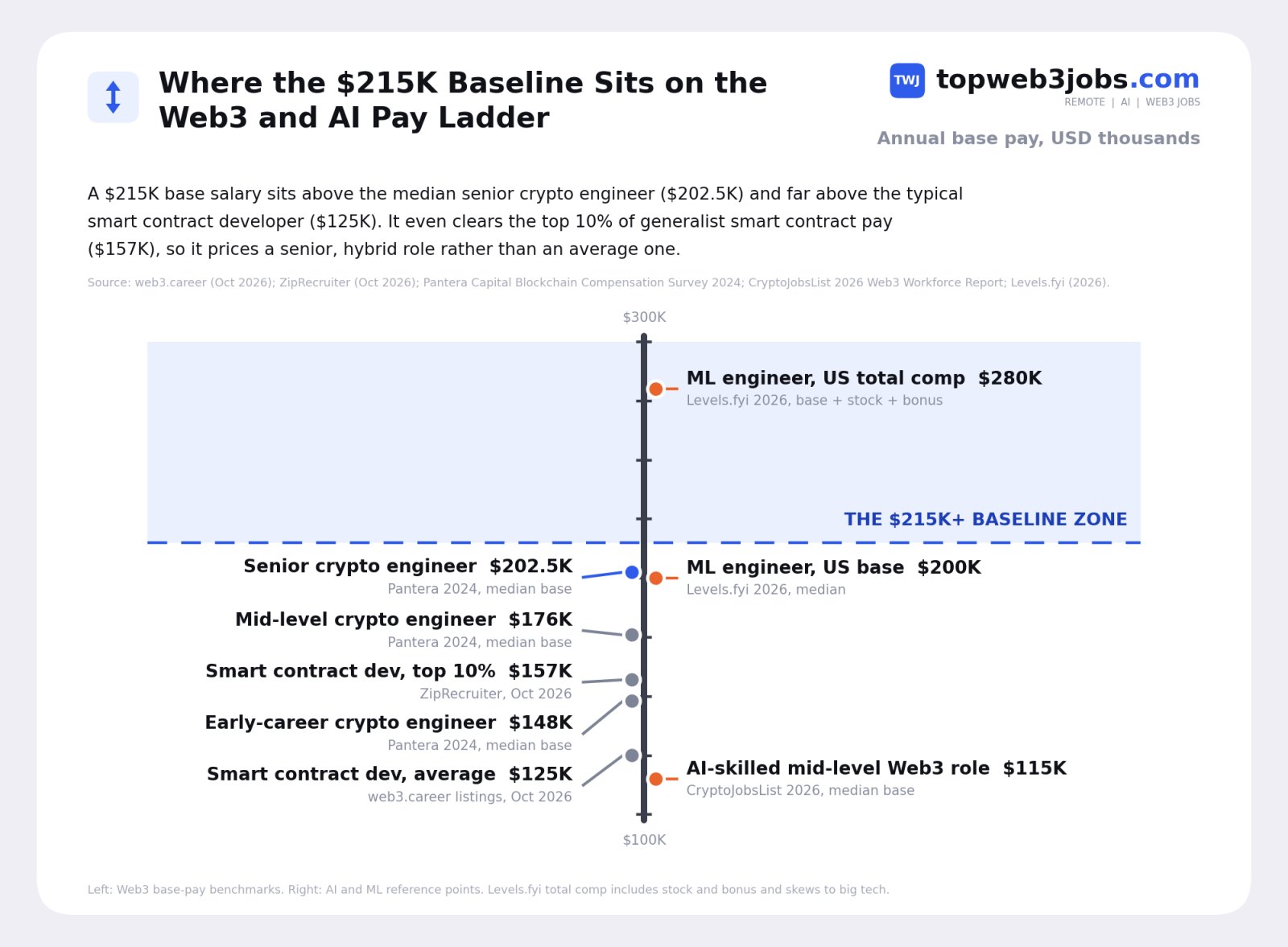
Three anchors sit just below it. Pantera's survey found a $202,500 median for senior crypto engineers. Levels.fyi shows a $200,000 median base for US machine learning engineers. And lifting the $130,400 median smart contract salary by PwC's 62% AI premium gives about $211,000.
So $215K is the rounded figure just above all three. It is a senior, base-pay number. It is not what the average smart contract developer earns, and it excludes stock and tokens.
What Smart Contract Developers Earn on Their Own
Smart contract work pays well, but the typical figure is far below the baseline.
web3.career puts the average smart contract developer salary at $125,000, with listings ranging from $60,000 to $250,000. ZipRecruiter shows a $130,400 median, and says the middle 80% of US smart contract developers earn between $76,500 and $157,000.
That makes $215K about 37% above the 90th percentile of the generalist pool. It is a price for something rarer than a smart contract developer.
Experience moves the number a lot. Pantera's 2024 survey covered more than 1,600 respondents in 77 countries, and 82% of them worked fully remote. Its median engineering base was $148,021 for early-career engineers, $176,000 for mid-level and $202,500 for senior. Year over year, those medians rose 25.6%, 14.5% and 4.9%, so pay is rising fastest at the bottom of the ladder.
Posted salaries tell a similar story at the top. SailOnchain reports a $202,483 median across 265 crypto engineering postings.
What AI and ML Engineers Earn
AI pay depends heavily on the employer.
Levels.fyi shows a median total compensation of about $280,000 for US machine learning engineers, with a median base of $200,000. Its data skews toward big tech, so it describes the top of the market rather than the middle.
Web3 job boards show lower numbers. A web3.career snapshot from April 2026 lists an average of $180,000 for machine learning engineers and $120,000 for AI engineers. Averages on that board move from month to month, but the gap to $215K is clear.
Inside Web3, AI skills carry a smaller premium than they do across the wider economy. The CryptoJobsList 2026 Web3 Workforce Report found a $115,000 median for mid-level roles with AI requirements, against $95,000 for those without, a 21.1% premium. Crypto.news reported that AI mentions in Web3 job posts rose from 23% to 53.1% in twelve months.
What Hybrid Roles Pay in Practice
The clearest pay data for hybrid roles comes from listings and role guides.
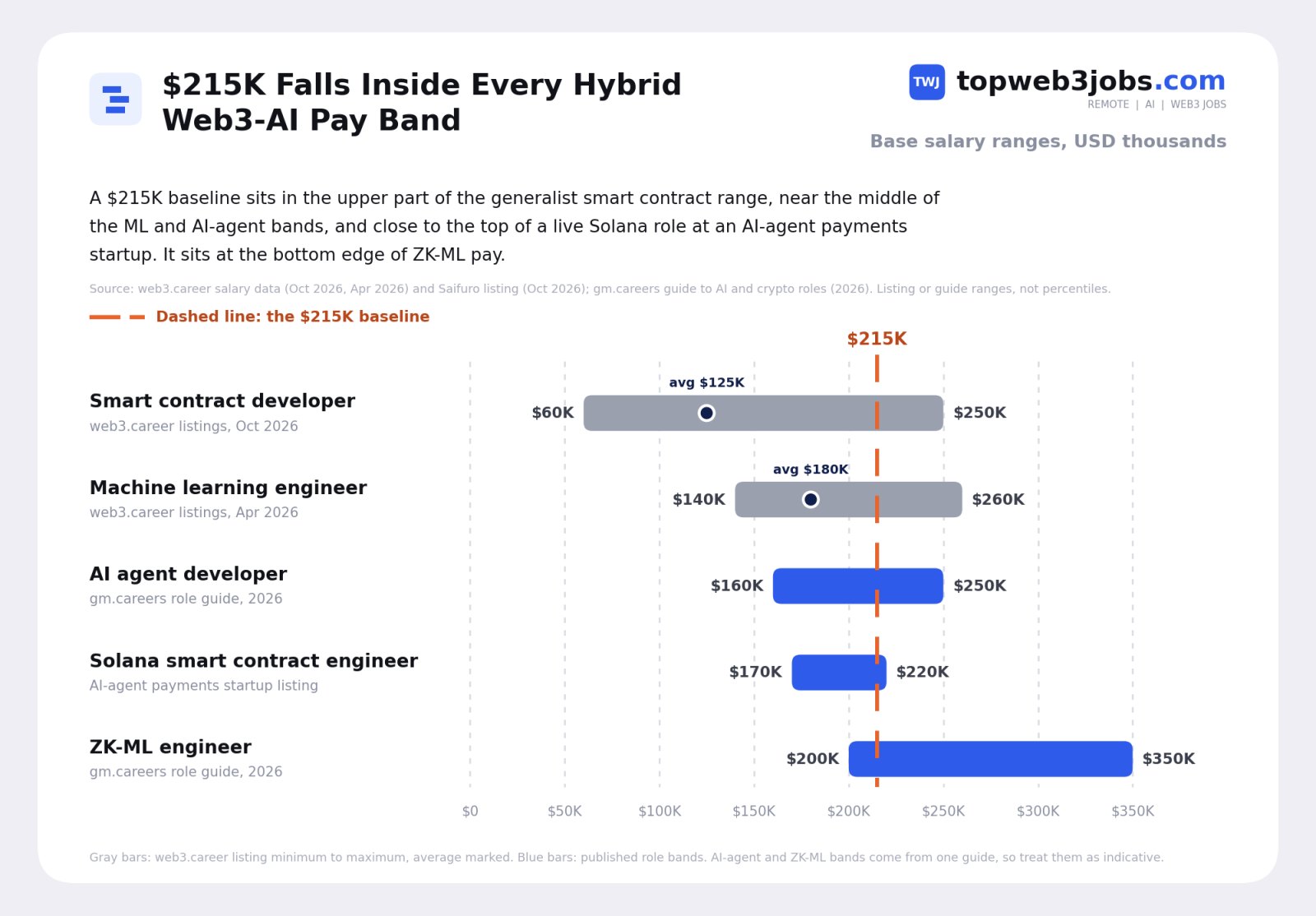
A Solana smart contract engineer role at Saifuro, a company that checks payments AI agents try to make against a mandate a human approved earlier, lists $170,000 to $220,000. A second listing from the same company, for the product engineer who builds the console where finance teams watch their agents spend, shows $190,000 to $225,000.
gm.careers, a career site, gives base ranges of $160,000 to $250,000 for AI agent developers and $200,000 to $350,000 for ZK-ML engineers. It puts on-chain data science and ML roles lower, at $140,000 to $220,000.
Set against those ranges, $215K sits in the upper part of the generalist smart contract range, near the middle of the ML and AI-agent bands, close to the top of the Saifuro listing, and at the bottom edge of ZK-ML pay.
Where the Premium Comes From
The size of the premium depends on which benchmark you trust.
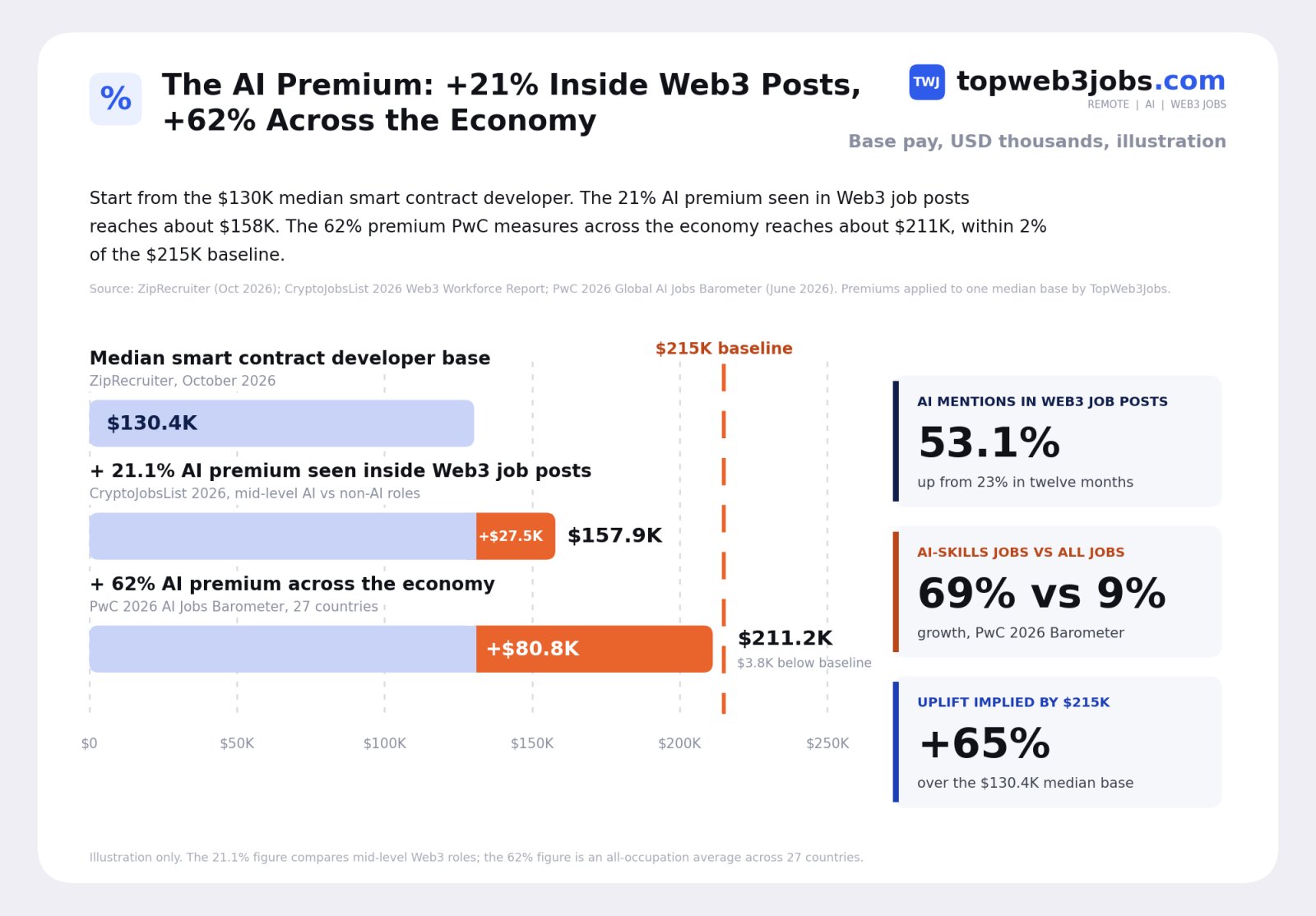
Start from the $130,400 median smart contract salary. Adding the 21.1% AI premium from Web3 postings gives about $158,000. Adding the 62% premium that PwC's 2026 AI Jobs Barometer measured across more than one billion job ads gives about $211,000.
A $215K baseline implies a 65% uplift on the median. That is close to the economy-wide AI premium and about three times the one seen in Web3 postings.
PwC also found that jobs requiring AI skills grew 69%, against 9% for the total jobs market.
The Catch: The Label Alone Does Not Pay $215K
The Web3 data does not show that adding "AI" to a smart contract title pays $215K. The Web3 premium of 21.1% would take a $130,400 base to roughly $158,000, which is about $57,000 short.
Our reading is that the rest comes from seniority and scope. The postings above ask for production experience, ownership of a codebase, or work on systems where agents move money. The Saifuro listing, for example, says finding bugs for a bounty or doing security research is a plus. That is the kind of experience that also commands a senior price in pure smart contract work.
There is a second risk. AI mentions in Web3 job posts have more than doubled in a year. If AI skills become a standard requirement, the premium for having them may shrink, because the skill stops being scarce.
PwC adds a related warning for newcomers. As summarized by LetsDataScience, it found AI-exposed entry-level US roles are seven times more likely to ask for traditionally senior skills.
How Hybrid Engineers Can Price Themselves
The steps below are a TopWeb3Jobs editorial guide based on the data above.
Price against the senior anchor, not the average. The senior crypto engineer median of $202,500 is a better reference than the $125,000 generalist average. Aim for $215K only when you can show senior-level ownership.
Show both stacks in one body of work. Public smart contracts alongside agent code, evals or an audit tool prove the hybrid claim. A single repository that connects the two is stronger than two separate portfolios.
Separate base from total compensation. Levels.fyi's $280,000 median for ML engineers includes stock and bonus. Compare base to base, and value tokens or equity separately. Pantera found nearly 88% of token vesting schedules ran over four years in 2024.
Use posted bands as evidence. A listing that states $170,000 to $225,000 for a hybrid role gives you a documented range to point to when you negotiate.
Ask how pay is delivered. Pantera found 9.6% of respondents were paid in crypto in 2024, most of them in stablecoins, with USDC at 63% and USDT at 28.6%. Confirm the currency, the payroll provider and who pays tax and fees.
Read the Numbers With Care
The $215K baseline is a TopWeb3Jobs framing, not an official statistic. It describes senior roles at funded teams, not every smart contract developer.
Job-board figures mix titles, countries and employers. The web3.career ranges are listing minimums and maximums, not percentiles, and monthly snapshots can swing. Posted ranges come from employers that choose to publish pay, and they are not accepted offers.
Pantera's figures come from a 2024 survey of all engineering roles, not only smart contract or AI work. Its respondents skewed senior, and 72% were outside the United States.
Levels.fyi skews toward large technology companies and includes stock and bonus.
The AI agent and ZK-ML bands come from a single career-site guide, so treat them as indicative. The $211,000 figure in this report applies PwC's all-occupation premium to a smart contract median, which is an illustration and not a measured outcome.
The 21.1% Web3 premium compares mid-level roles only, using CryptoJobsList's own listing database.
What to Watch Next
First, the premium itself. If AI mentions in Web3 job posts keep rising from 53.1%, the 21.1% premium could narrow. If it holds, the baseline is likely to stay near $215K for senior hybrid roles.
Second, agent payments. Companies that build controls for AI agents that spend money are hiring engineers who can write onchain programs and agent systems together. Their salary bands are an early read on where hybrid pay settles.
Third, the seniority tilt. If employers keep asking for senior skills in junior-looking roles, the path into the $215K bracket will run through proven work rather than job titles.
The data supports one clear conclusion today: $215K is a fair baseline for a senior engineer who can ship both smart contracts and agent systems, but it is a senior, funded-team number, and the average smart contract developer earns closer to $125,000 to $130,000.
Sources:
- Pantera Capital, Blockchain Compensation Survey 2024 (published August 2025): engineering medians by seniority, remote share and pay in crypto; web3.career, smart contract developer salary data and listings (October 2026; April 2026 snapshot): averages, ranges and the Saifuro listing; ZipRecruiter, Smart Contract Developer salary page (October 2026): median and percentiles
- PwC, 2026 Global AI Jobs Barometer (June 15, 2026): AI skills wage premium and job growth; CryptoJobsList, 2026 Web3 Workforce Report, as reported by crypto.news: mid-level AI premium and share of AI mentions in job posts; Levels.fyi, Machine Learning Engineer, United States (2026): median base and total compensation
- SailOnchain, crypto engineering listings (2026); gm.careers, AI and crypto role guide (2026): AI agent and ZK-ML bands