 TopWeb3

Why Base Salary Is Only Part of the Number
A salary is the most visible part of an offer, but it is not the whole cost to the employer or the whole value to you.
The US Bureau of Labor Statistics reports that private employers spent an average of $46.89 an hour per worker in June 2026. Wages and salaries made up $32.82 of that, or 70%. Benefits made up the other 30%.
For full-time workers, the split was 68.5% wages and 31.5% benefits.
Remote offers often handle that 30% differently. A US employee gets a health plan, a retirement match and paid leave. A contractor abroad may get none of these, or a set of cash stipends in their place. The only way to compare offers fairly is to put every piece into the same yearly dollar figure.
Step 1: Put a Dollar Value on Health Cover
Health coverage is usually the largest benefit, and the easiest one to undervalue.
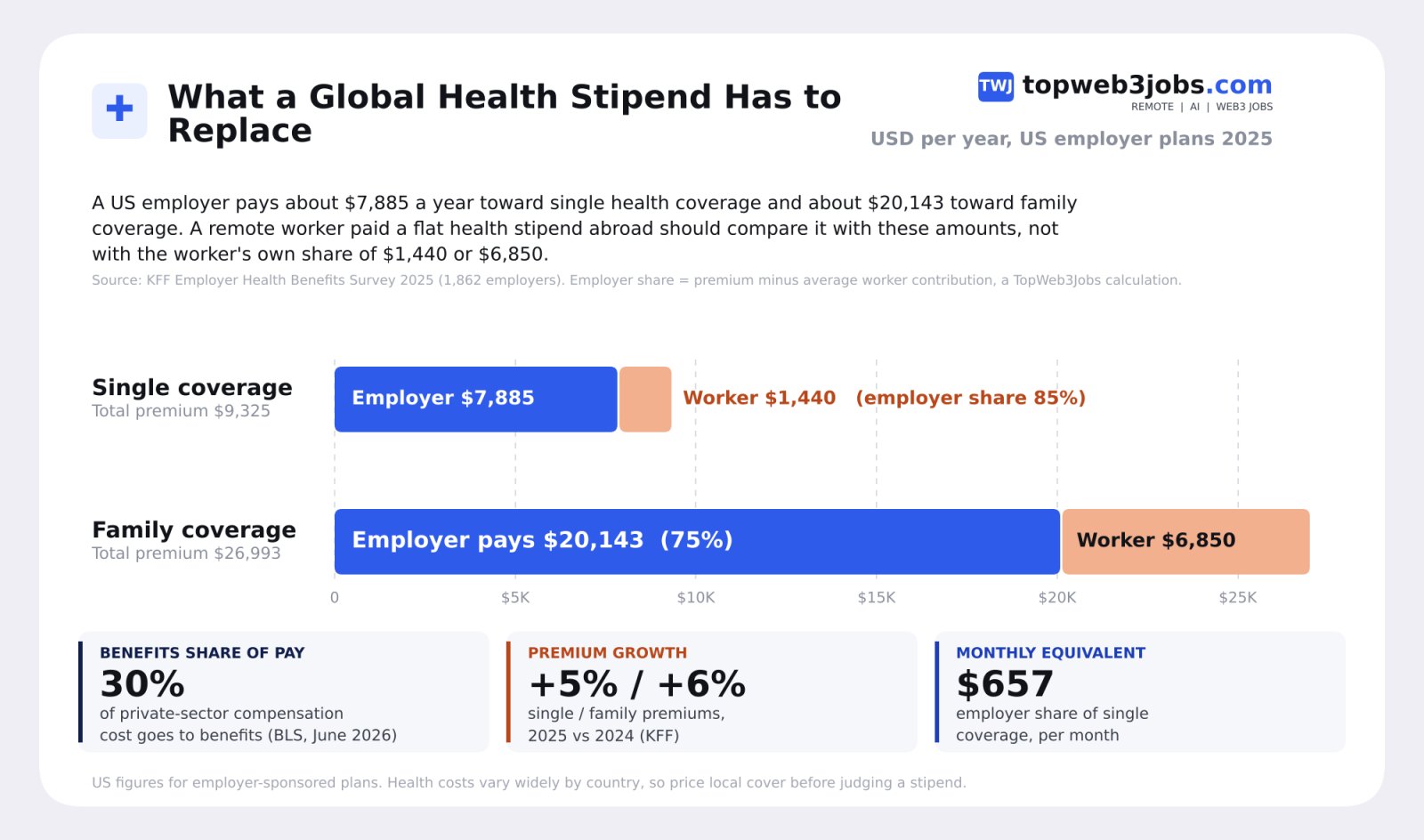
The KFF 2025 Employer Health Benefits Survey found average annual premiums of $9,325 for single coverage and $26,993 for family coverage. Single premiums rose 5% from 2024, and family premiums rose 6%.
Workers paid an average of $1,440 toward single coverage and $6,850 toward family coverage. That means employers paid about $7,885 and $20,143. For single coverage, that is about $657 a month.
That employer share is the number a remote health stipend has to replace. If an offer includes a $200 monthly health stipend, it covers about $2,400 a year. That may be enough in a country where private cover is cheaper, but it is far below the value of a typical US plan.
Many crypto offers are built this way. Pantera's 2024 survey found 82% of crypto professionals work fully remote, and many are hired as contractors across borders rather than as local employees with a company health plan.
Step 2: Price the Co-Working Budget
Remote does not always mean working from home. Many remote workers pay for a desk.
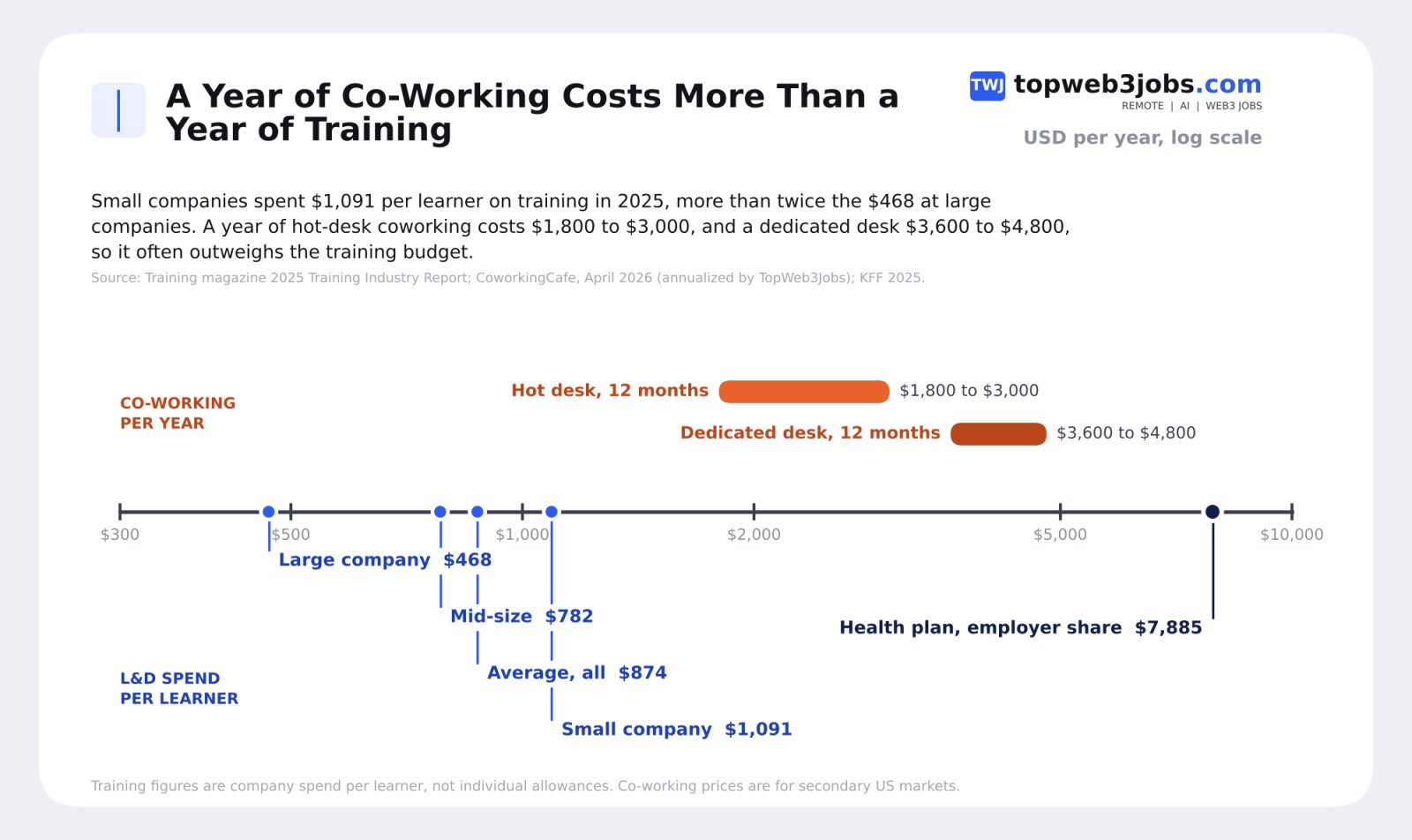
CoworkingCafe's April 2026 analysis puts a hot desk at $150 to $250 a month in most secondary US markets. A dedicated desk costs $300 to $400 a month. Over a year, that is $1,800 to $3,000 for a hot desk and $3,600 to $4,800 for a dedicated one.
Remote allowances vary widely. Velocity Global's review of common remote allowances found coworking budgets of $250 to $500 a month in typical examples, and noted that Buffer once offered $200 a month for working from coffee shops.
If an offer has no co-working budget and you plan to use one, subtract the cost from your comparison. If it includes one, add it.
Hybrid offers change this math. Some employers expect people near a hub to use the company office instead. In London, for instance, many of the 23 open crypto and AI roles listed today are tied to an office or a hybrid schedule, so a separate co-working budget is less likely to be part of the package.
Step 3: Count the Learning Allowance
Learning and development budgets are smaller, but they still add value, especially in fast-moving fields like AI and crypto.
The Training magazine 2025 Training Industry Report found US companies spent an average of $874 per learner in 2025, up from $774 in 2024. Small companies spent the most per person at $1,091. Mid-size companies spent $782 and large companies $468.
Training time fell, though. Employees averaged 40 hours of training in 2025, down from 47 hours the year before.
These are company spend figures, not individual allowances. Velocity Global gives $1,000 a year as a typical career development budget in remote offers. That roughly matches what small companies already spend per person.
Putting It Together: A Worked Example
The example below is a TopWeb3Jobs illustration, not financial or tax advice.
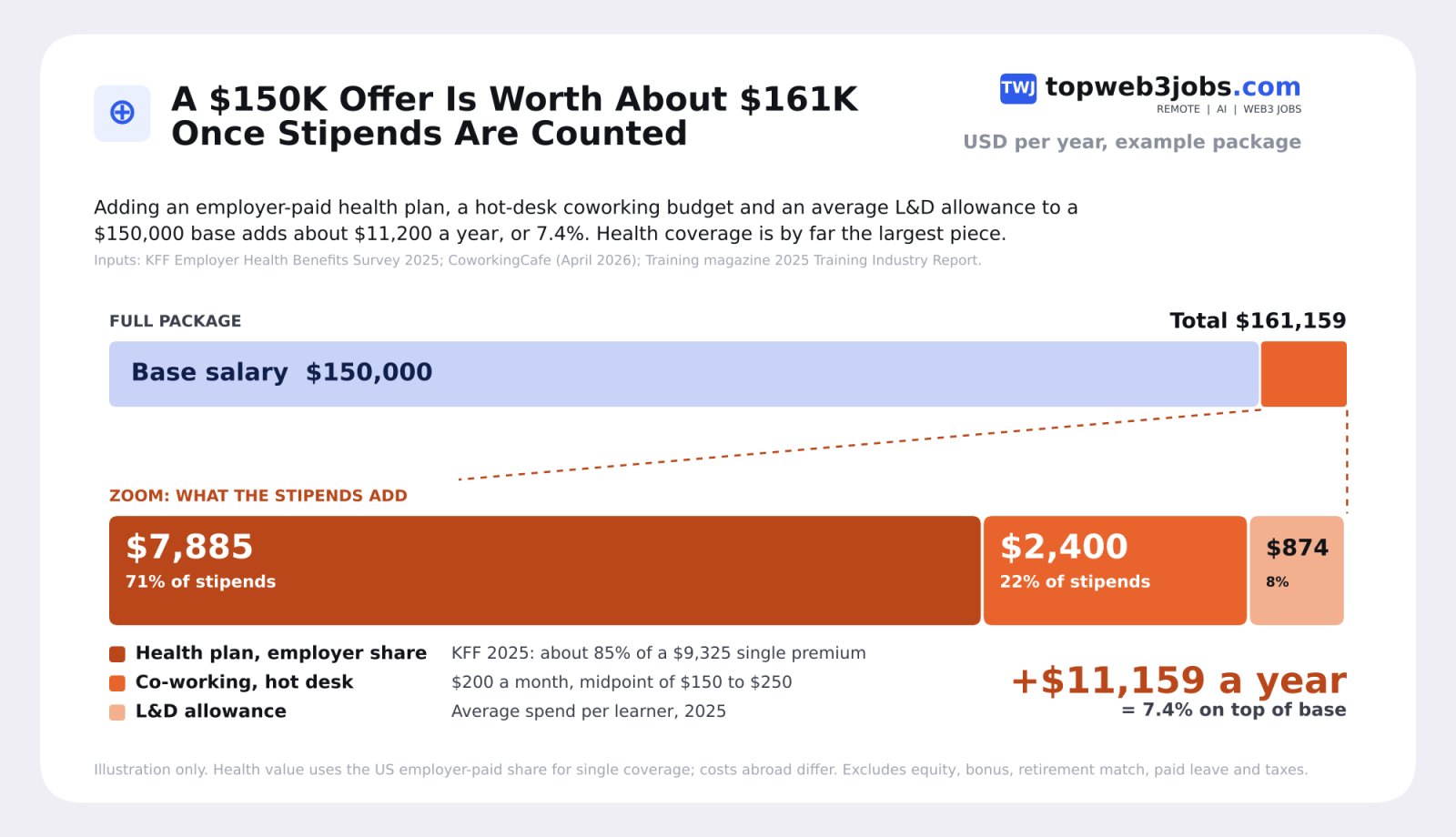
Take a remote offer with a $150,000 base salary. Add the employer share of a single health plan at $7,885, a hot-desk co-working budget at $200 a month or $2,400 a year, and an average L&D allowance of $874.
The total comes to $161,159. The three extras add $11,159, or 7.4% on top of the base. Health makes up 71% of that, co-working 22% and learning 8%.
Now compare a second offer with a $155,000 base and no stipends. On salary alone, it looks $5,000 better. Once the stipends are counted, it is about $6,000 worse.
| Component | How to value it | Example value |
|---|---|---|
| Base salary | Full amount | $150,000 |
| Health plan or stipend | Employer-paid share or stipend amount | $7,885 |
| Co-working budget | Monthly amount x 12 | $2,400 |
| L&D allowance | Yearly budget | $874 |
| Home office and internet | Monthly or one-time amount, spread over the year | Add if offered |
| Equity or tokens | Discount heavily until liquid | Not included |
How to Use This When You Negotiate
Ask for the full list. Many companies do not put stipends in the offer letter. Ask for every allowance in writing, with the amount and whether it is paid monthly, yearly or as a reimbursement.
Check whether stipends are taxed. Cash stipends are often treated as taxable income, while reimbursed expenses may not be. The difference changes what you actually keep.
Trade stipends for salary when it makes sense. If you do not need a co-working space, ask whether that budget can be added to base pay instead.
Compare health cover locally. A stipend that looks small in US terms may buy good private cover in your country. Get a local quote before deciding.
Benefits are rarely listed in job ads, which makes this harder. Many teams list only a salary range, if that. MoonPay, for example, has 31 roles on TopWeb3Jobs, and only two of its listings show any pay figure at all. Even product roles at crypto and AI companies, where posted ranges run up to $250,000, rarely list stipends. Expect to ask.
Read the Numbers With Care
The health figures are for US employer-sponsored plans. Costs abroad can be much higher or much lower, depending on the country and the plan.
The training figures measure what companies spend per learner, not what an individual is given to spend.
The co-working prices are ranges for secondary US markets from one industry article. Desks in major cities cost more, and prices in Latin America or Asia-Pacific can differ a lot.
Our worked example leaves out retirement contributions, paid leave, bonuses and equity, which can add much more than the stipends shown here.
What to Watch Next
First, health stipend design. As more companies hire across borders, expect more offers to replace health plans with fixed stipends. Workers should check how those stipends keep up with premium growth of 5% to 6% a year.
Second, return-to-office pressure. As US employers pull roles back to offices, co-working budgets may shrink for hybrid staff while staying common for fully remote teams.
Third, learning budgets for AI. Spend per learner rose 13% in 2025. As AI tools change how work gets done, L&D allowances may become a bigger part of remote packages.
The data supports one practical rule today: before you compare two remote offers, convert every stipend into a yearly dollar figure and add it to the base, because the offer with the higher salary is not always the one that pays more.