 TopWeb3

A remote tech resume has a harder job than an office-based one. It has to prove you can deliver results without anyone watching you work, and it has to do that in front of a much bigger crowd of competing applicants. The numbers on both points are stark, and they shape how you should write every bullet.
The competition problem: remote roles draw a far bigger pile
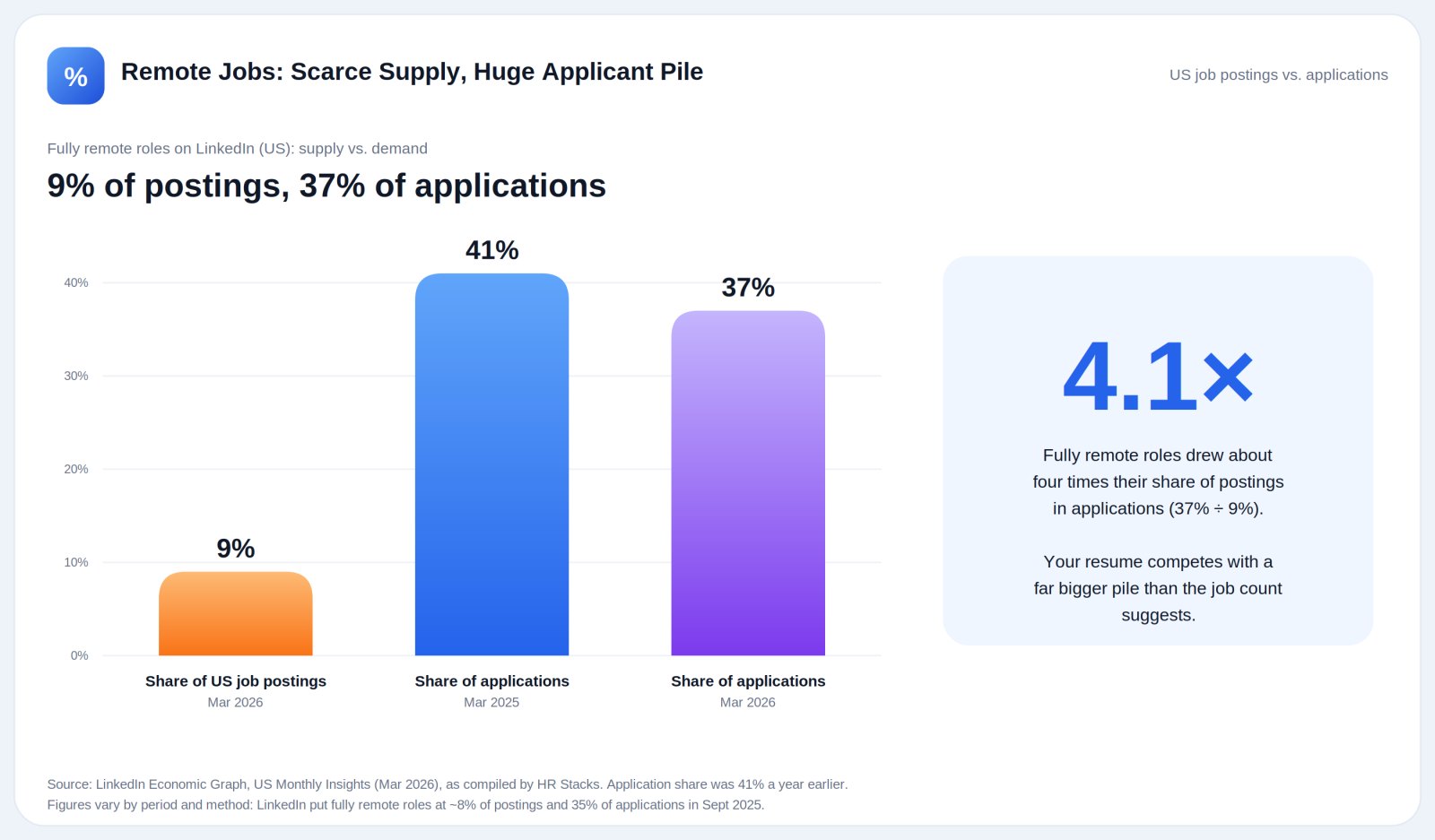
Start with what you're up against. According to LinkedIn Economic Graph data (March 2026, compiled by HR Stacks), fully remote roles made up about 9% of US job postings but drew 37% of all applications. That is down from 41% a year earlier, but it still works out to roughly four times their share of postings. Other snapshots differ slightly by period and method. LinkedIn put the figures at about 8% of postings and 35% of applications in September 2025. The direction is the same in every cut: remote openings attract disproportionate demand.
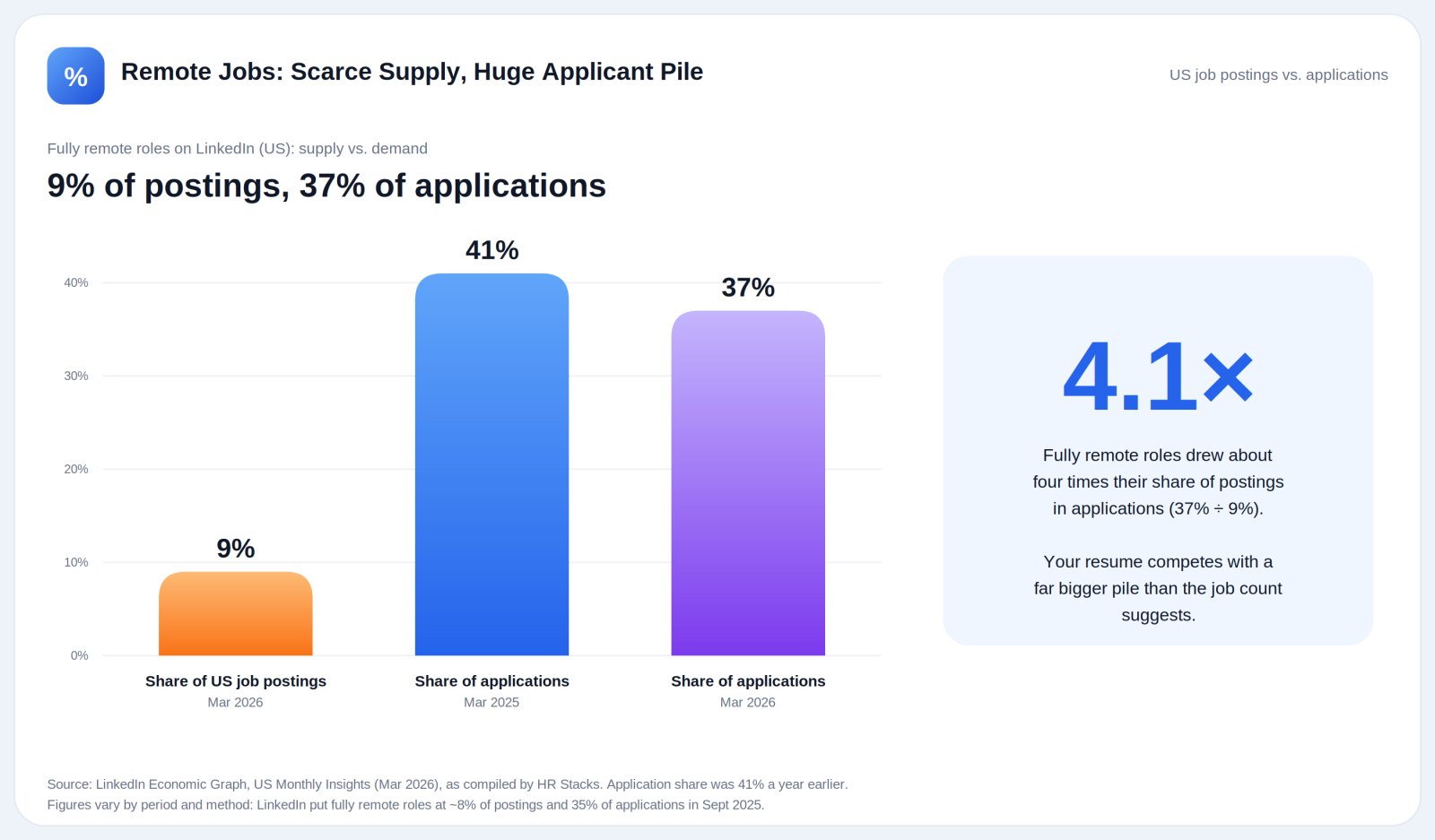
The practical takeaway is that a generic resume is easy to lose in a remote applicant pile. You can't count on a recruiter reading your work history closely, so each line has to carry evidence on its own.
The attention problem: you get seconds, not minutes
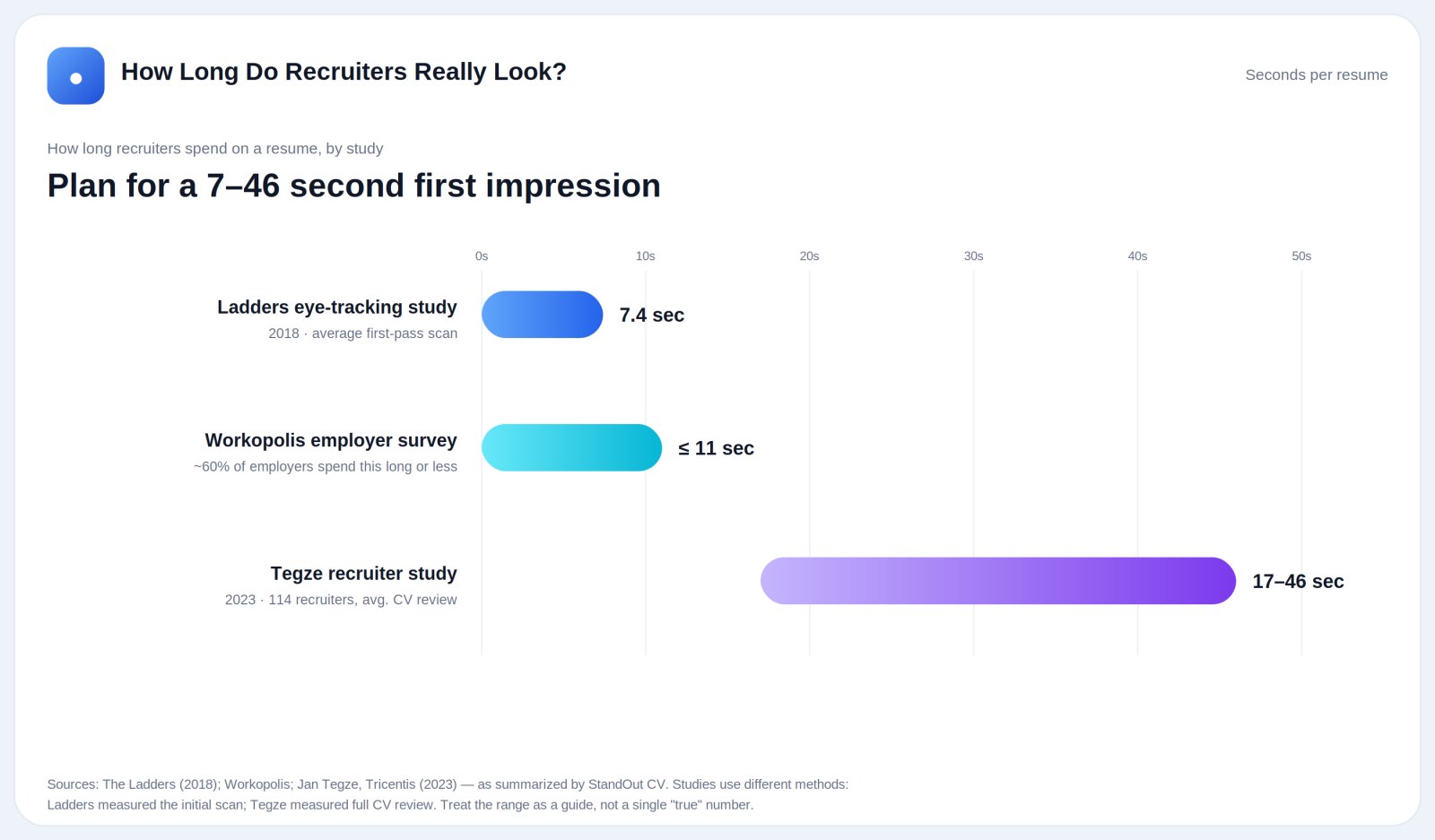
Recruiters do not read resumes the way candidates hope. The most-cited figure comes from a 2018 Ladders eye-tracking study, which found an average first-pass scan of 7.4 seconds. A Workopolis survey found that roughly 60% of employers spend 11 seconds or less before deciding to save or close a resume. A later study by Jan Tegze of Tricentis, covering 114 recruiters in 2023, measured a longer average review of 17 to 46 seconds.
These studies measure different things. The Ladders figure is an initial scan, while Tegze tracked fuller reviews. A fair reading is that you have somewhere between seven and forty-odd seconds to earn a second look, and the top third of the page does most of the work.
That is why metrics belong at the front of your bullets. A number can be read at a glance, and a vague duty cannot.
Pillar 1: Quantify impact, not activity
Weak bullets describe what you were responsible for. Strong bullets state what changed because of you. For a remote role, favor outcomes that were clearly yours and clearly measurable, since your manager may never have seen you do the work.
A simple formula works well: action verb + what you changed + measurable result + scope or timeframe.
Illustrative templates (replace the brackets with your own real numbers):
- Reduced median API response time from [X] ms to [Y] ms across [N] services, cutting [support tickets / infrastructure cost] by [Z]%.
- Shipped [feature] to [N] users in [timeframe], lifting [activation / retention / conversion] from [A]% to [B]%.
- Automated [manual process], saving the team about [N] hours per week.
Only claim what you can defend in an interview. If you don't have an exact figure, use a defensible estimate and label it as one ("~30%").
Pillar 2: Show user scale and system scale
Scale tells a hiring manager how much responsibility you've handled, and it matters even more when they can't watch you work day to day. Pick the one or two scale numbers that fit your role:
- Users: monthly or daily active users, customers, accounts, or downloads
- Traffic and load: requests per second, events processed per day, data volume
- Reliability: uptime, incident counts, recovery time
- Team and surface area: number of services owned, engineers supported, teams you coordinated
Pair the scale with your contribution. "Worked on a platform with 2M users" says little about you. "Owned the checkout service handling [N] requests/day and cut failed payments by [X]%" says a lot.
Pillar 3: Put network growth on the page
For distributed applicants, your network is evidence of something remote employers care about: you can build trust and get things done across distance. It is also a hiring advantage in its own right.
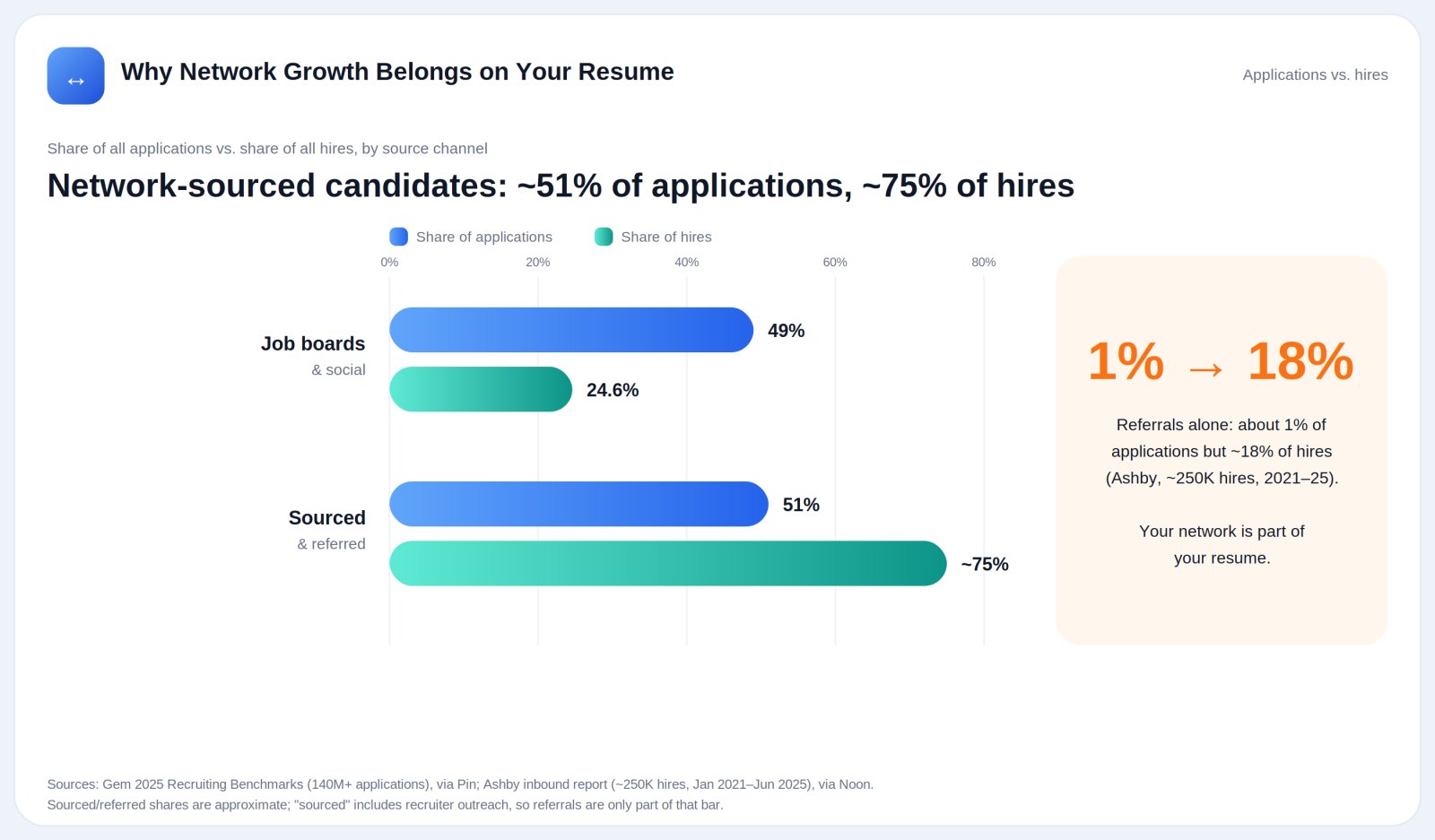
Gem's 2025 recruiting benchmarks, based on more than 140 million applications, found that job boards and social channels produced about 49% of applications but only about 24.6% of hires. Sourced and referred candidates were roughly half of applications and about three-quarters of hires. Ashby's analysis of roughly 250,000 hires (January 2021 to June 2025) found referrals were about 1% of applications and about 18% of hires. The sourced/referred figures are approximate, and "sourced" includes recruiter outreach, so referrals are only part of that group. Even so, the pattern is consistent: candidates who arrive through people tend to convert far better than cold inbound applicants.
You can turn network growth into resume proof without name-dropping:
- Grew an open-source project from [N] to [M] GitHub stars, with [K] outside contributors.
- Built and moderated a developer community of [N] members across [N] time zones.
- Wrote [N] technical posts or talks reaching [N] readers or attendees.
- Mentored [N] engineers, [X] of whom were promoted or hired.
Then make the network usable. Link a current LinkedIn profile and a portfolio or GitHub, and ask former colleagues for referrals before you apply cold.
Remote-specific signals to weave in
Beyond the three pillars, distributed teams look for evidence that you work well asynchronously:
- Time-zone reach: "Coordinated releases across [N] time zones with [X] hours of overlap."
- Written communication: design docs, RFCs, and runbooks you authored, ideally with how many people used them.
- Ownership without supervision: projects you scoped and delivered end to end.
- Tools: the async and collaboration stack you've actually used, listed once rather than scattered.
A quick checklist before you submit
- Does the top third of the page contain at least two numbers?
- Does every recent bullet state a result, not just a duty?
- Is there at least one scale figure (users, traffic, or systems) for your most recent role?
- Is there one line of network or community proof?
- Is every figure something you can explain and defend in an interview?
- Is the resume tailored to the specific posting?
The central idea is simple: make every line easy to verify and quick to read. In a crowded remote market, a short list of concrete numbers will beat a long list of responsibilities.