 TopWeb3
Key Data
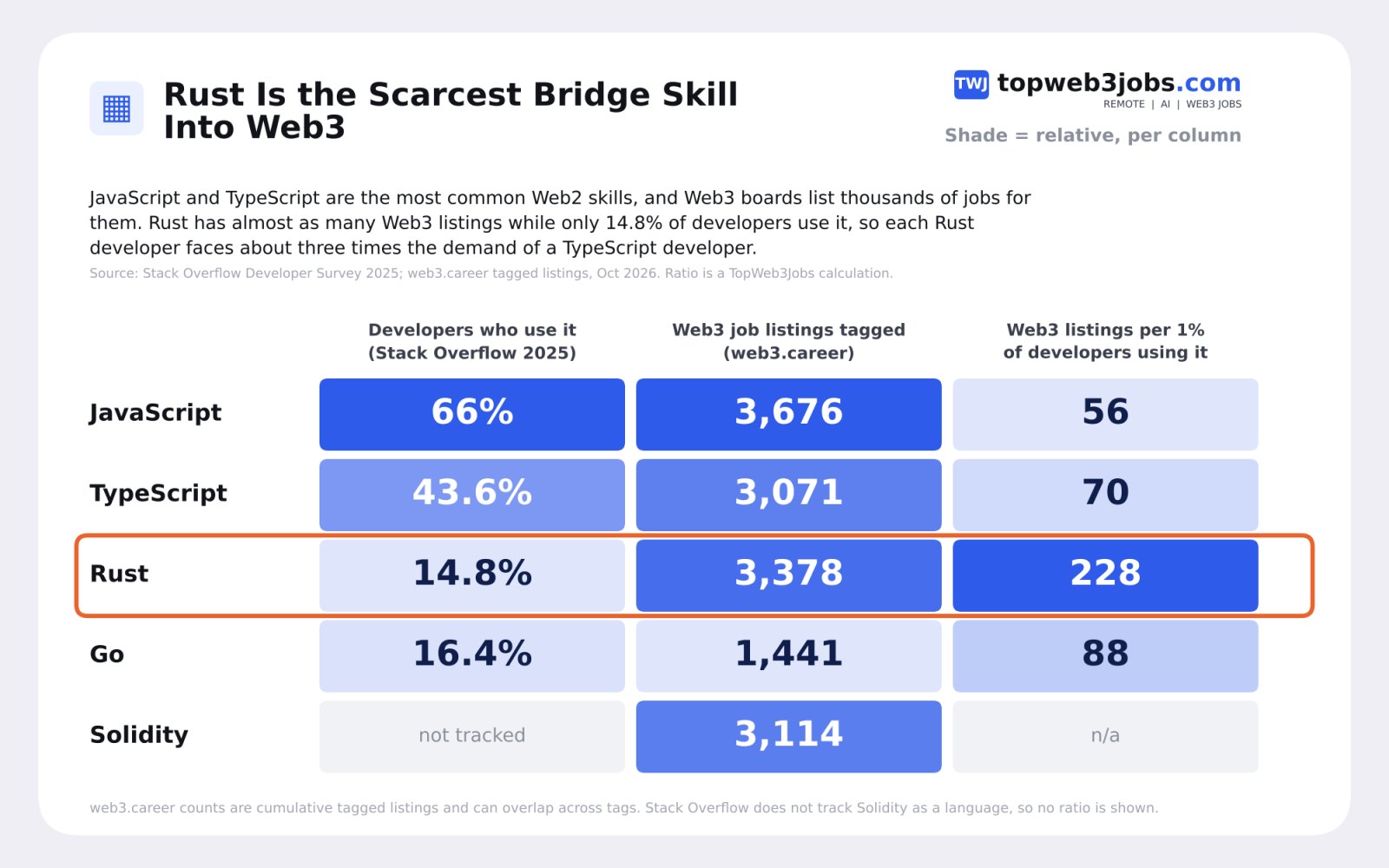
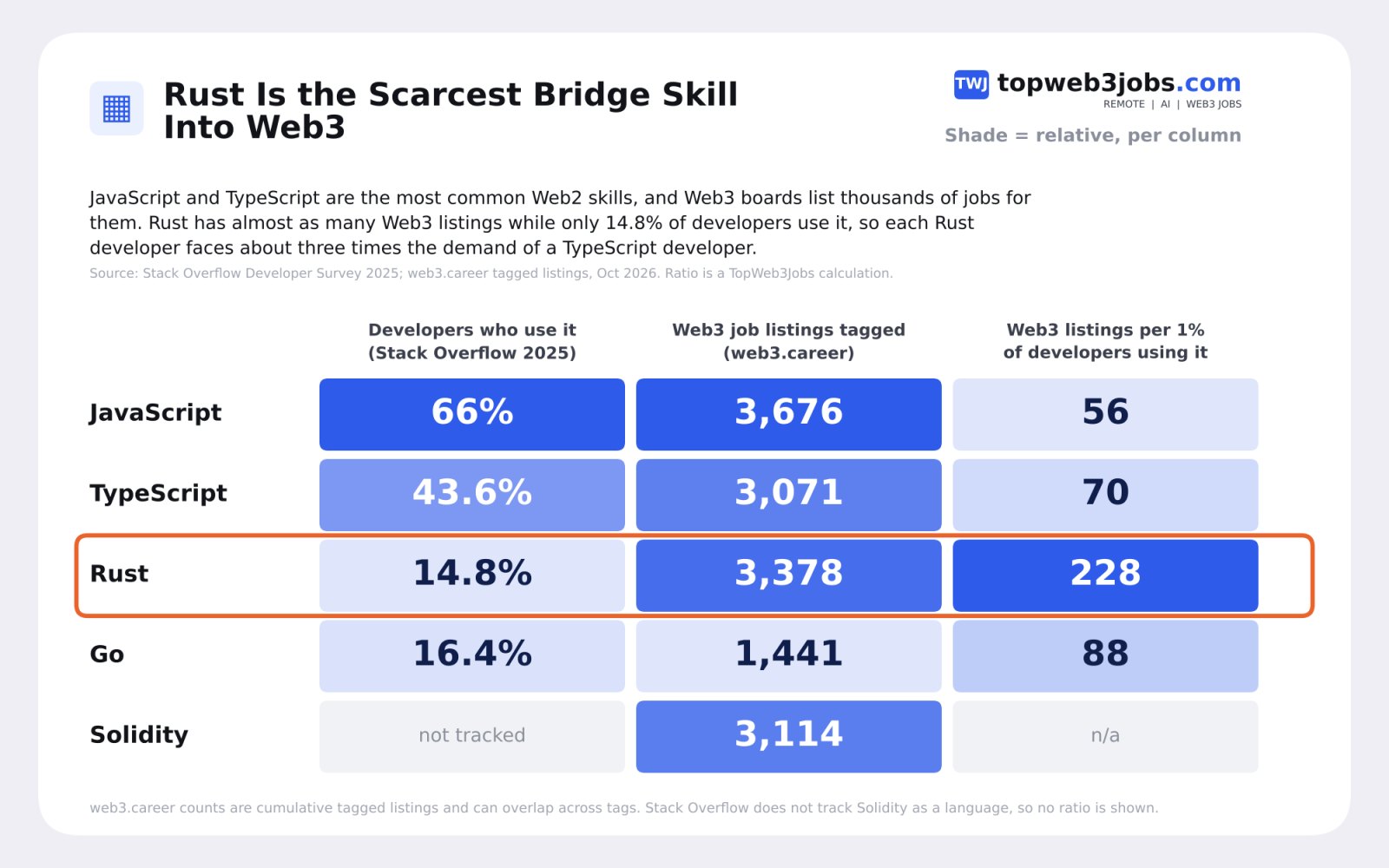
- JavaScript is used by 66% of developers and TypeScript by 43.6%. Web3 job boards list 3,676 JavaScript and 3,071 TypeScript roles
- Rust is used by only 14.8% of developers but appears in 3,378 Web3 listings, about 228 listings per percentage point of users, against 70 for TypeScript
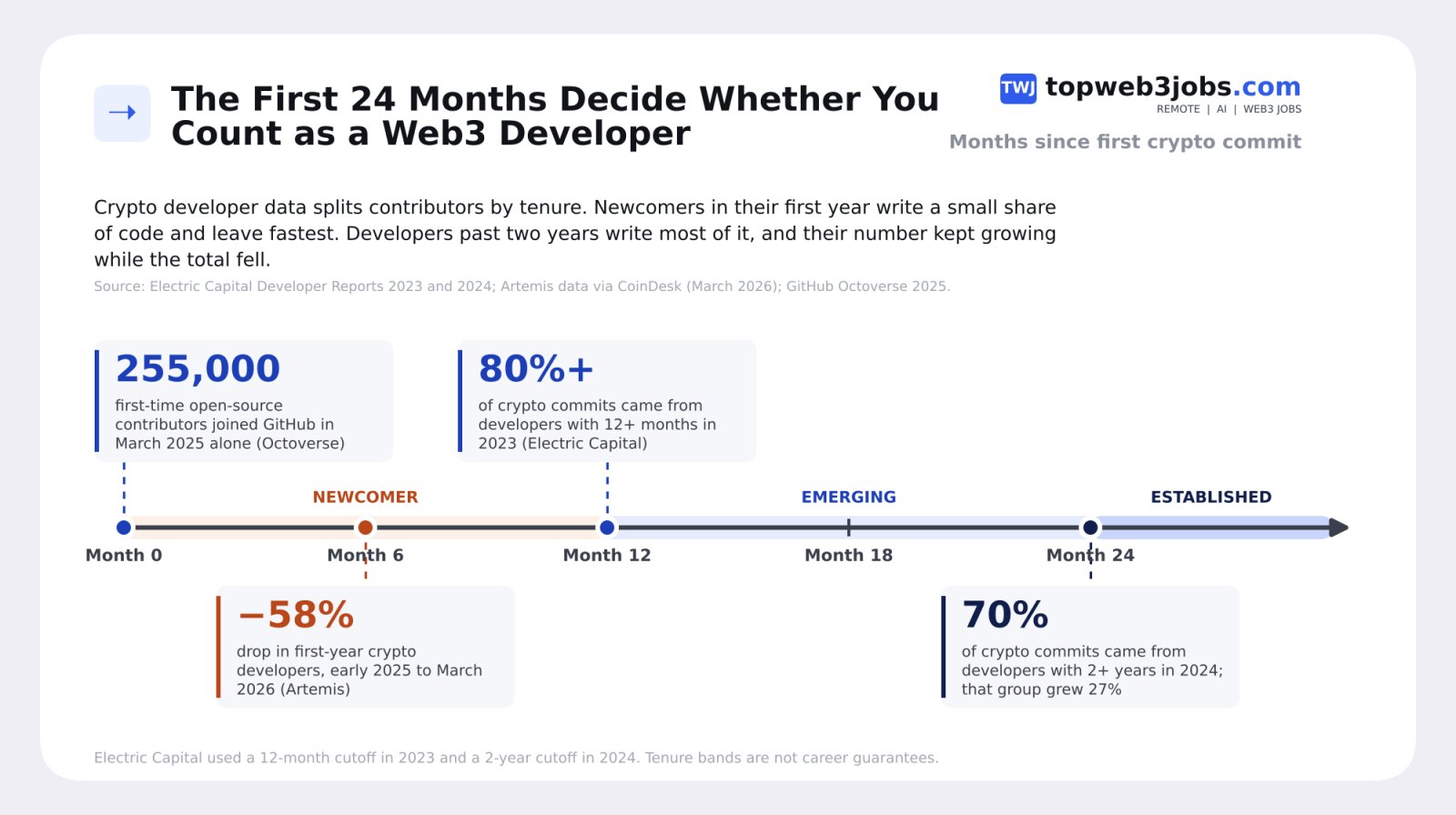
- In 2023, developers with 12 or more months in crypto wrote over 80% of commits. In 2024, developers with two or more years wrote 70% and their number grew 27%
- First-year crypto developers fell 58% between early 2025 and March 2026
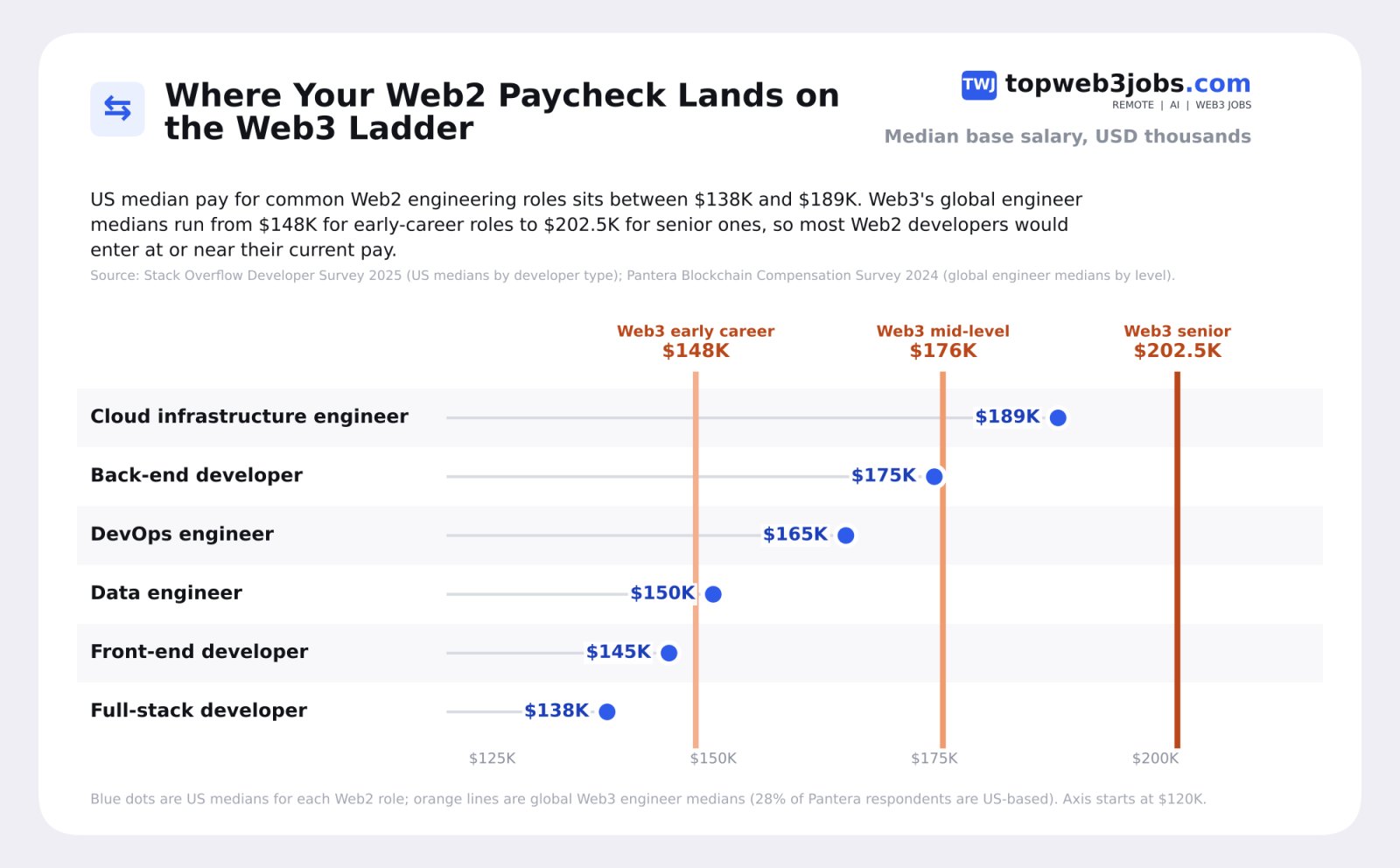
- US medians for common Web2 engineering roles range from $138,000 to $189,000. Web3's global engineer medians run from $148,000 early-career to $202,500 senior
- One in three crypto developers works on more than one chain
Your Web2 Skills Already Count
The first barrier most developers imagine is language. The data says it is smaller than it looks.
The Stack Overflow Developer Survey 2025 found that 66% of developers use JavaScript and 43.6% use TypeScript. Those same languages run most wallets, dApp front ends, indexers and SDKs. On web3.career, 3,676 listings are tagged JavaScript and 3,071 TypeScript.
TypeScript is also now the most used language on GitHub, with about 2.64 million monthly contributors in 2025.
Wallet teams show how direct the overlap can be. Phantom is hiring frontend and full-stack engineers who can work from anywhere, with nine of its fourteen open roles listed as remote worldwide.
Rust Is the Skill That Moves the Needle
The language where demand most outruns supply is Rust.
Only 14.8% of developers use Rust, according to Stack Overflow. Yet web3.career lists 3,378 Rust jobs, more than it lists for TypeScript. That works out to about 228 Web3 listings per percentage point of Rust users, against 70 for TypeScript and 56 for JavaScript.
Rust is also the language developers most want to keep using. It was the most admired language in the 2025 survey, at 72.4%.
Solidity remains central to Ethereum and its rollups, with 3,114 tagged listings. Stack Overflow does not track it, so its supply cannot be measured the same way. Go appears in 1,441 listings.
The Commit History That Counts: The First 24 Months
Language skills get a profile read. A crypto commit history gets it believed.
Crypto developer research groups contributors by how long they have been active. Electric Capital counts a developer as monthly active if they commit to a crypto repository in a given month. It then sorts them by tenure.
In 2023, developers with 12 or more months in crypto wrote over 80% of all commits. The developers who left that year were mostly newcomers in their first year.
In 2024, Electric Capital moved the line to two years. Developers past that mark wrote 70% of commits, and their number grew 27% even as total developers fell 7%.
The first year is where people drop out. Artemis data reported by CoinDesk shows first-year crypto developers falling 58% between early 2025 and March 2026.
No recruiter publishes a minimum commit count. But these tenure bands are the closest public yardstick for what "experienced in Web3" means. The 12-month mark is where a profile leaves the group that writes under 20% of the code. The 24-month mark is where it joins the group writing most of it.
The Skill Metrics to Build Into Your Profile
The checklist below is a TopWeb3Jobs editorial guide built from the data above. It is not a published hiring standard.
Monthly activity, not streaks. Electric Capital's measure is simple: at least one commit to a crypto repository each month. Twelve consecutive active months is a stronger signal than a burst of 300 commits in one weekend.
Commits in repositories you do not own. Contributions merged into a protocol, SDK or client show that other engineers accepted your code. GitHub recorded 518.7 million merged pull requests in open source over the past year, and 255,000 first-time open-source contributors joined in March 2025 alone. The bar is getting one of those pull requests into a crypto project.
More than one chain. One in three crypto developers works on more than one chain. Work in both an EVM language such as Solidity and a Rust-based ecosystem such as Solana widens the set of teams that can use you.
A security record. Audit contests give newcomers a ranked, public record. Code4rena alone ran 512 audits and logged 26,898 unique findings from more than 16,600 registered wardens before winding down in 2026. Security is also where hiring is tightest. OpenZeppelin, for one, is looking for a principal security engineer focused on Solana, open to applicants worldwide.
Your Web2 history, kept visible. Do not hide your earlier work. A long Web2 record shows staying power. Pin two or three Web2 projects next to your crypto work so reviewers can see both.
| Profile signal | Data behind it | Target to aim for |
|---|---|---|
| Active months in crypto repos | Electric Capital monthly active definition | 12 straight months, then 24 |
| Merged PRs to others' crypto repos | Octoverse merged PR volume | A steady handful, not one |
| Chains covered | One in three developers is multi-chain | At least two ecosystems |
| Rust or Solidity code | 3,378 Rust and 3,114 Solidity listings | One language shipped to production or testnet |
| Audit contest findings | 26,898 findings across 512 Code4rena audits | At least one valid medium or high |
What Your Pay Looks Like on the Other Side
The pay question is usually the last worry, and the data is reassuring.
Stack Overflow's US medians for common Web2 engineering roles run from $138,000 for full-stack developers to $189,000 for cloud infrastructure engineers. Back-end developers sit at $175,000.
Pantera's 2024 survey puts the global median Web3 engineer at $148,021 early in a career, $176,000 at mid-level and $202,500 at senior level. Early-career Web3 pay also rose 25.6% in a year, the fastest of any level.
In other words, most Web2 developers would enter Web3 near their current pay, and senior Web3 engineers earn more than most Web2 medians. The comparison mixes US and global figures, since 72% of Pantera's respondents are outside the US, so read it as a rough guide.
Relocation is rarely required. 82% of crypto professionals work fully remote. For developers who prefer an office, hybrid seats exist too. MoonPay, for instance, has a senior to staff engineering role based in Berlin on a hybrid schedule.
Read the Numbers With Care
The web3.career figures are cumulative tagged listings, not live openings, and one job can carry several tags. They show relative demand, not the number of vacancies today.
Stack Overflow's language shares are from survey respondents, who skew toward active and engaged developers.
Electric Capital changed its tenure cutoff from 12 months in 2023 to two years in 2024, and Artemis tracks a narrower set of repositories. The milestones describe the developer population, not a guarantee for any one person.
The pay comparison uses US medians for Web2 roles and global medians for Web3 roles, so Web3 pay for US-based engineers is likely higher than shown.
What to Watch Next
First, Rust demand. If Solana, Move-based chains and ZK systems keep growing, the gap between Rust demand and Rust supply should keep widening.
Second, newcomer retention. A 58% fall in first-year developers means less competition for those who stay. It also means fewer peers to learn from.
Third, AI overlap. Many developers who left crypto in 2025 moved to AI. Teams building AI agents that use wallets and smart contracts may become the most natural bridge for Web2 developers in 2027.
The data supports one practical conclusion today: your Web2 skills get you considered, but twelve months of steady, merged crypto commits is what gets you hired.
Sources:
- Stack Overflow, Developer Survey 2025: language use, Rust admired rating and US median salary by developer type; web3.career, tagged job listings for JavaScript, TypeScript, Rust, Solidity and Go (October 2026); GitHub, Octoverse 2025: TypeScript contributors, merged pull requests and first-time contributors
- Electric Capital, Developer Report 2023 (as reported by CryptoPotato, July 2023) and Developer Report 2024: tenure cohorts, share of commits, multi-chain developers; Artemis data via CoinDesk (March 12, 2026): first-year developers down 58%; Code4rena platform statistics: audits, findings and wardens
- Pantera Capital, Blockchain Compensation Survey 2024 (August 2025): engineer medians by level, early-career growth, remote share; TopWeb3Jobs company and city listings (October 2026)