 TopWeb3

Key Data
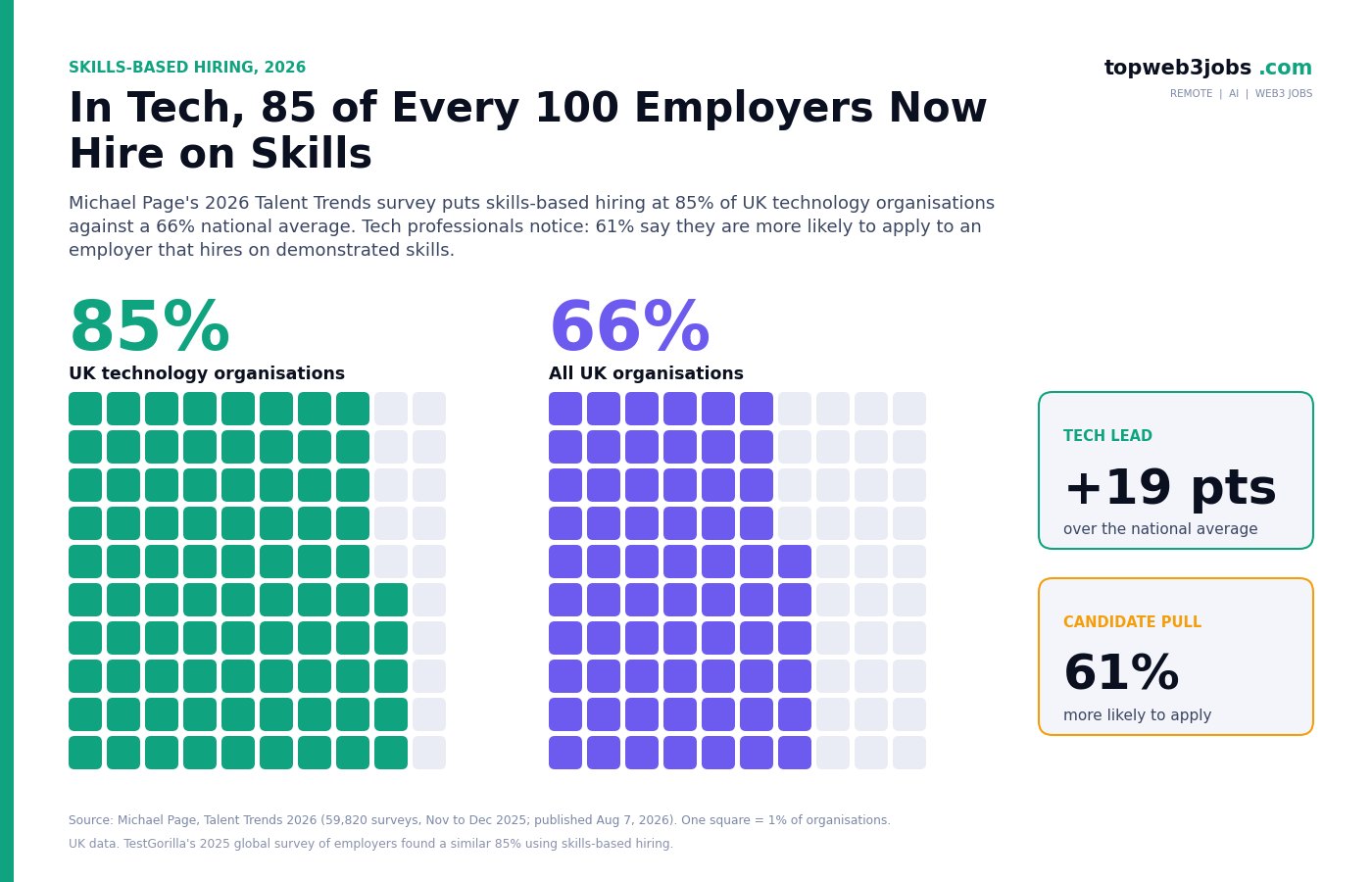
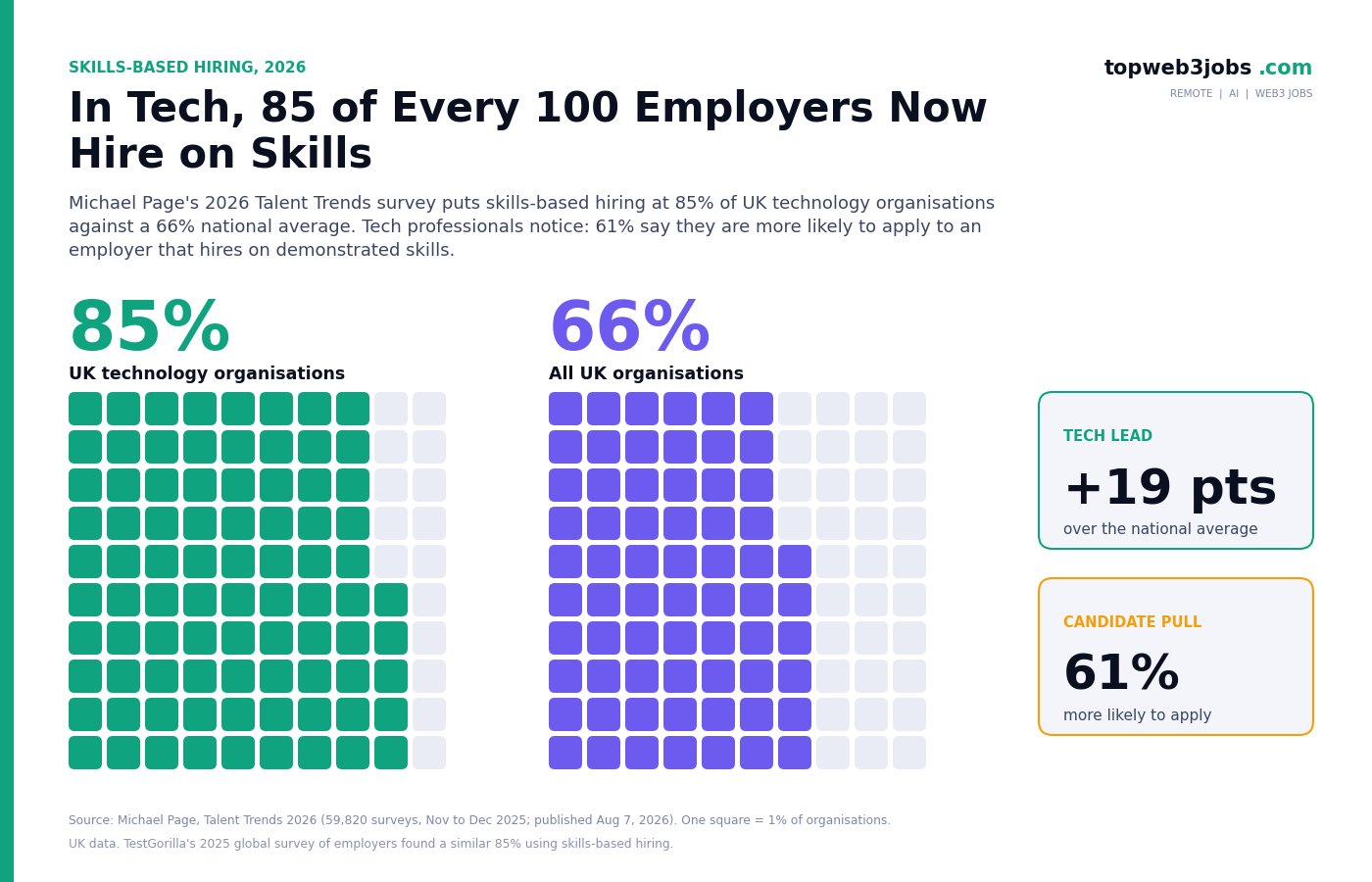
- 85% of UK technology organisations hire on demonstrated skills, against a 66% national average, according to Michael Page's 2026 Talent Trends report
- 61% of technology professionals say they are more likely to apply to an employer that hires on demonstrated skills, per the same survey
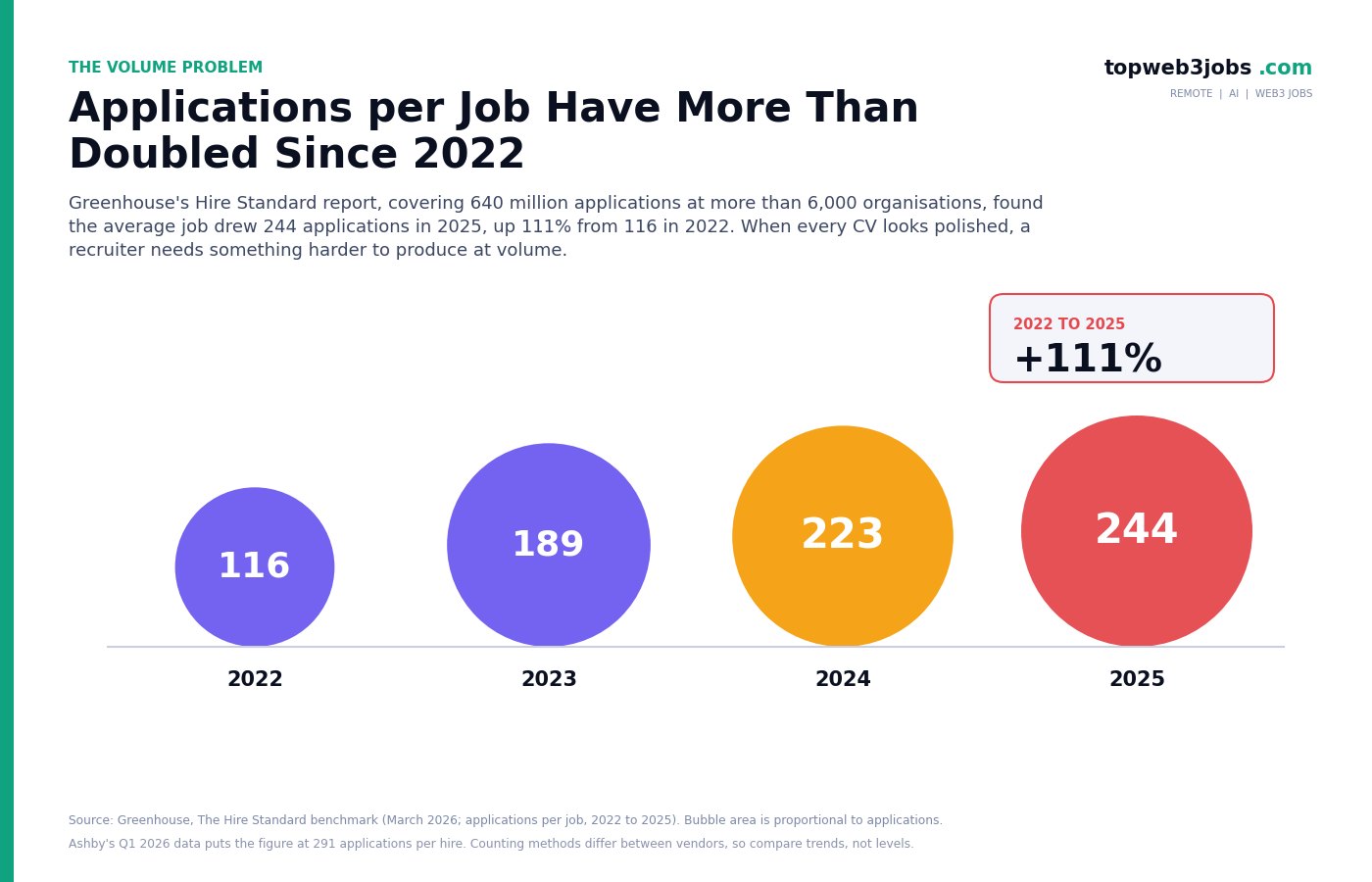
- The average job drew 244 applications in 2025, up 111% from 116 in 2022, according to Greenhouse
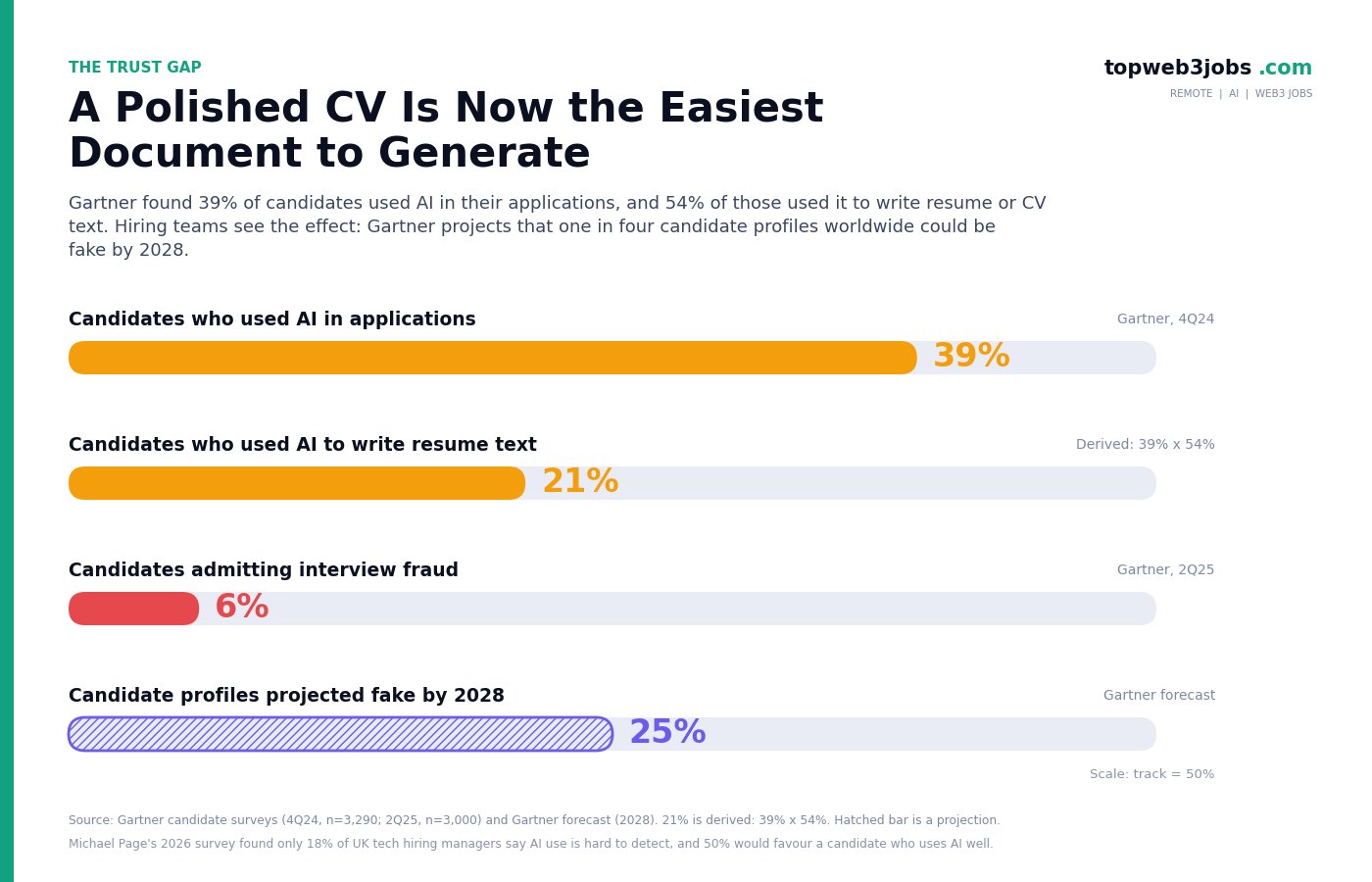
- 39% of candidates used AI in their applications, and 54% of those used it to generate resume or CV text, according to Gartner
- Gartner projects that one in four candidate profiles worldwide could be fake by 2028
- 6% of candidates in a Gartner survey admitted to interview fraud
- 85% of employers used skills-based hiring in 2025, up from 81% in 2024 and 73% in 2023, per TestGorilla
Why the CV Lost Its Signal
A resume used to cost effort to produce, and that effort was a weak filter. It no longer is.
Greenhouse analysed more than 640 million applications across more than 6,000 organisations. Applications per job rose from 116 in 2022 to 189 in 2023, 223 in 2024 and 244 in 2025. Ashby's separate data puts the figure at 291 applications per hire in the first quarter of 2026. Counting methods differ, so the levels are not directly comparable, but the direction is the same.
The cause is not only more job seekers. Gartner's survey of 3,290 candidates found 39% used AI during the application process, and 54% of those used it to generate resume text. That works out to about one candidate in five handing in an AI-drafted resume. Gartner's 2025 survey also found 6% of candidates admitted to interview fraud, meaning they impersonated someone or had someone impersonate them. Looking ahead, Gartner projects one in four candidate profiles could be fake by 2028.
Hiring teams are noticing. In the Michael Page survey, 28% of hiring managers across sectors say they find it hard to tell whether a candidate used AI, though the share drops to 18% in technology. Half of technology hiring managers say they would be more likely to hire someone who used AI well. The issue for recruiters is less AI itself than the loss of a signal. A fluent CV tells you the candidate has access to the same tools as everyone else.
What Employers Say They Do Instead
The shift to skills-based hiring is now the majority position in tech. Michael Page's survey, run between November and December 2025, found 85% of technology organisations hire on demonstrated capability, with the sector ahead of the 66% national average. Technology hiring managers said the biggest benefits were fairness and reduced bias (52%), easier matching to current and future skill needs (51%) and better identification of candidate capabilities (45%).
TestGorilla's 2025 global survey tells a similar story. It found 85% of employers using skills-based hiring, up from 81% the year before, and 76% using skills tests to validate candidates.
Candidates want it too. 61% of technology professionals in the Michael Page data said they would be more likely to apply to an employer that hires on skills rather than education or career history. That makes the approach a recruiting tool as well as a screening one.
Remote teams have extra reason to lean this way. A tech lead who cannot sit next to a new hire for the first month needs to know before the offer whether the person can ship. Public code is one of the few forms of evidence that can be inspected asynchronously, in any time zone, before a conversation starts.
What "Verified" Evidence Looks Like
No survey we could find measures the exact claim in the headline, that a stated share of remote tech leads prefer repositories over CVs. What the data does show is the direction of travel, plus older evidence that technical leaders already looked at project work. A HackerRank survey of 39,441 developers in 2017 found 84.1% of the executives who responded said they looked at an applicant's GitHub project work as an indicator of on-the-job skill. It is a dated and self-selected sample, so we use it as context rather than proof.
Instead of listing tools, the more useful question is what makes a piece of evidence hard to fake. Based on the patterns above, the strongest signals tend to share four traits.
History. A repository with commits spread over months, review comments and issue threads is much harder to fabricate than a single polished upload. Contribution to other people's projects, with merged changes, shows the work survived review.
Runnable output. Code that builds, tests that pass and a deployed contract or demo that can be called are checkable in minutes. For protocol builders, a verified contract address and its audit report are checkable on-chain.
Reproducibility for model work. For AI and machine learning roles, the equivalent is a model repository with a model card, training or evaluation scripts and benchmark results that a reviewer can rerun. A claim of "fine-tuned a large language model" is a buzzword. An evaluation harness that reproduces a score is evidence.
Explained decisions. Michael Page's survey found technology hiring managers prize creativity, analytical thinking and communication most. A short write-up of why a design was chosen, and what was rejected, shows all three better than another demo app.
This is TopWeb3Jobs editorial analysis, not survey data. It reflects what tends to be checkable, and every item on the list can be inspected without trusting the candidate's own description of it.
For candidates, the practical move is to put those links where a recruiter will see them first. Browse the engineering openings and check how each posting asks you to show your work.
Where the CV Still Matters
The resume is not dead, and the data is clear on that. TestGorilla found 67% of employers screen resumes before using skills-based methods, and 33% do so afterwards. Michael Page's own release describes CV review as the top use of AI in technology recruitment, at 37%. In practice, a CV still decides who gets looked at first.
The reason is volume. Ashby data, as summarised in a hiring-benchmark guide, put the share of applications reaching an interview at around 3.6% for technical roles in the first quarter of 2026. At that ratio, a recruiter cannot open every repository, so the first cut still happens on paper.
The sensible reading is a two-step process. The CV gets you past the first filter. Evidence gets you through the second. A resume that links directly to the strongest two or three pieces of work, rather than listing keywords, serves both stages.
This also fits what we see on our own board. Our research on the 45% surge in protocol and AI job postings found demand growing for protocol and AI roles, fields where public, checkable work is easy to produce.
How Candidates and Hiring Leads Can Act on This
The steps below are a TopWeb3Jobs editorial guide based on the data above.
For candidates: lead with proof. Put two or three links at the top of your resume, each tied to a specific result. A short line on what the work does and what you personally built is worth more than a skills list.
Keep a clean public record. A pinned repository with a clear README, working setup instructions and tests tells a reviewer in two minutes whether to keep reading.
Show your decisions. Write up trade-offs. For model work, publish the evaluation method and the numbers, including where the model fails.
For hiring leads: ask for evidence early. Putting a link request in the application form filters volume faster than another resume screen. Review the same artefact for every candidate so comparisons are fair.
Check the history, not just the snapshot. Look at commit patterns, review threads and who actually wrote the work. A fresh repository with one large upload deserves a follow-up question.
Use a short paid or live task to confirm. Gartner advises building anti-cheating safeguards into evaluation. A short live walk-through of the candidate's own code is hard to outsource to a tool, and it tests whether they understand what they submitted.
Do not drop the CV completely. Use it for context, tenure and references, and give the evidence the deciding weight.
Read the Numbers With Care
We could not find a published survey behind an 82% figure for remote tech leads preferring repositories to CVs, which is why this report leads with the 85% skills-based hiring figure that is documented. The two measure different things, and neither says directly that a given share of tech leads prefer repositories.
The Michael Page data is from the UK. It covers technology organisations broadly, not only remote teams or Web3 and AI companies. The survey is large, at 59,820 responses, but is weighted toward the firm's own candidate database and is self-reported.
The Gartner fake-profile figure is a forecast, not a count. The interview fraud figure comes from candidate self-reports, and the 21% figure we derive for AI-written resumes is 39% multiplied by 54%, which assumes the two survey answers apply to the same group.
Greenhouse and Ashby count applications differently, and vendors measure different customer bases. The 3.6% interview rate is quoted through a secondary guide rather than Ashby's own report.
The HackerRank figure is from 2017, covers a small group of executives and measures attitudes rather than hiring decisions.
What to Watch Next
First, whether skills-based hiring translates into specific formats. Today it means tests, take-homes and portfolios in about equal measure. A standard way to share verified work would make comparisons easier for everyone.
Second, fraud pressure. If Gartner's forecast is even partly right, identity checks and live verification will become routine for remote roles, and public work with a long history will become more valuable.
Third, AI-assisted code. As more of a repository is written with tools, reviewers will care less about who typed each line and more about whether the author can explain and defend it.
The data supports a modest conclusion today. The buzzword resume has lost most of its signal, and the majority of tech employers say they now hire on demonstrated skill. Repositories and reproducible work are the clearest form of that evidence, but the CV still gets the first look.
Sources:
- Michael Page, Talent Trends 2026 technology findings (August 7, 2026); TestGorilla, The State of Skills-Based Hiring 2025 and 2024
- Gartner candidate surveys (4Q24, 1Q25, 2Q25) and fake-profile forecast, as reported by HR Dive, SHRM and others; Greenhouse, The Hire Standard benchmark (March 2026); Ashby, Recruiter Productivity 2026
- HackerRank Developer Survey 2017, as reported by IT Pro Today; TopWeb3Jobs listings and research pages (October 2026)